Thursday, May 7, 2009

"Kiss my quiver"

When I first started working at the store, I had no kid-cred until I started recommending Rick Riordan's Percy Jackson and the Olympians series. It's a really fun series, steeped in Greek mythology in a freshly imagined way, with enough action to make a screenwriter drool. Fittingly, it is owned by Disney Hyperion, so I'm sure we'll see a movie, or a TV show, or something soon.
The last book in the series,
The Last Olympian, came out this Tuesday, and after I was sure there were enough copies in the store to create 3 displays, I borrowed a copy and read it over the last couple of days. It was exactly everything that the series has always promised: monsters, swords, angry gods, pithy dialog, pretty girls and a hero who loves nothing more than to charge into an angry mobs of monsters. So of course, it was good fun, just as all the other books were. However, the one thing I was a little disappointed about was the lack of emotional depth displayed in the face of extreme tragedy. While Riordan ups the body count considerably, killing kids and monsters and gods alike, the emotional reactions of the characters were very flat, not to mention very fleeting. And aside from making it a less compelling read, it may also do the further disservice of downplaying the psychological destruction that violence wreaks. I'd had no qualms with the glorified violence before, since it was all directed at monsters, who just dissolved and then reformed anyway. But in this last installment, the narrative voice Riordan uses seemed to get in his way a little, and he was unable to create a compelling psychological landscape. While that may seem like a lot to ask from a series about Greek gods squatting in Manhattan, The Battle of the Labyrinth, (the 4th installment, and my favorite in the series) addresses the difference in immortality achieved though art or through godliness. So clearly Riordan is capable of asking big questions.
But of course, I say this all with the caveat that this may be one of the most enjoyable series for kids out there right now. There's not a single kid I've turned onto this series that didn't like it, and it appeals to kids who spend all their time reading and reluctant readers alike. Plus, it's never a
bad idea to retell the Greek myths. I just wouldn't be quite so quick to compare it to Harry Potter, is all.

Friday, May 1, 2009

and to round out a tragedy binge, the following titles

I actually read The Higher Power of Lucky by Susan Patron right before I read Gayle Forman's If I stay. It won the 2006 Newbery Medal, and even some controversy over the use of the word scrotum on page one of this middle grade novel. I'm probably the last kid's bookseller in the world to read it, and of course, I loved it. Lucky is a little girl living with her guardian, Brigitte. Lucky's father is MIA and her mother passed away in a freak electrical accident. As Lucky starts to come to grips with what has happened to her mother, she also begins to fully appreciate the relationship she has with Brigitte. When she mistakenly comes to think that Brigitte is planning to leave her, Lucky panics. She hits her own rock bottom when she takes her anger out on Miles, a much younger boy she's friends with. Ultimately, Lucky is able to finally fully grasp what she has lost in her life, but also what she has gained. Simply written, and surprisingly funny in turns, The Higher Power of Lucky was everything that a Newbery winner should be. I was especially fond of Lucky's best friend and maybe crush Lincoln, who is the best knot-artist Lucky has ever met.
I'd been trying to get into one post apocalyptic novel and one urban fantasy novel with little to no luck when I decided to raid the advanced reader copy shelves at work. I picked up 10, and decided to read the first chapter of all of them, just to get a sense of either what I wanted to read, or what I wanted to give to kid reviewers. I found debut author Suzanne LaFleur's Love, Aubrey in the pile, and read it all in one night. Tonight, actually. I read the first chapter, same as the rest, but as soon as I tried to go back to my preexisting reading, all I was thinking about was this little girl. When the novel opens, Aubrey has been abandoned by her mother. Her grandmother quickly arrives on the scene, and moves Aubrey up to Vermont so that she can take care of her. Neither know where Aubrey's mother has gone, but Gram takes care of Aubrey as she slowly moves through the grieving process. The reader learns that Aubrey has lost both her little sister, Savannah and her father in a car accident. Because she was driving, Aubrey's mother feels responsible, and the pain of it cripples her. As Aubrey comes to grip with the pain in her life, she also begins to learn how to trust people again. Absorbing storytelling, and a very authentic kid's narrative voice made for an incredible emotional read. Like If I Stay, Love Aubrey moves elegantly between the present time of the story, and flashbacks to Aubrey's life before the accident, and before her mother abandoned her. In the end, I found myself so attached to Aubrey that I actually felt proud of her, and the way she handles her choices. From Random House Children's Books, Love, Aubrey comes out in hardback June 9.

Wednesday, April 29, 2009

Another Site!

So one my fellow students in the USF MFA program has a website! Mary wants to write for kids too, and reads way more than I do. So for more on all things kid lit, go to this link:

http://kidlit.com/

She has contests, so, you know. Go there.

Good grief.

So, I admit that things like seeing the crew from San Francisco getting eliminated on America's Best Dance Crew have made me cry. Once, a Campbell's soup commercial. It's true. So maybe it's fair to say it doesn't take much to make me cry. I'm a sucker. But, at the very least, I like to think I can tell when I've been sucker punched. And there are some things that earn the tears.
I recently read the new YA novel,
If I Stay, by Gayle Foreman, and cried and cried and cried and cried and then cried some more until my face hurt. It's about a girl named Mia who begins an out of body experience after she suffers a horrific car accident with her family. Her parents are dead on the scene, and her believably adorable younger brother is whisked away. The novel moves back in forth between the times before the accident, and after. What I found really compelling was the handling of the out of body conceit. Mia's body is comatose in the present action of the novel, and her spirit, her consciousness (or however you want to describe it) bears witness to visitations from her extended family, friends, and boyfriend.
When I was told what the conceit was, I had my reservations; it sounded a little Lovely Bonesish to me, and I seem to be the only person in the world who did not like that novel. But Foreman handles it elegantly, believably and most of all evocatively. The family and friends that create Mia's emotional landscape are empathetically and realistically portrayed. And while they are incredibly specific (a dad who used to love punk and now loves bow ties, for example) they also feel authentically universal in the love that binds them to one another. So while Mia struggles to decide between life with the crippling pain of losing her family and something that may be much easier, the reader is invited to look for moments of love in their own life.
And so even though the novel centers around the absolute worst-case scenario of family loss, it is ultimately a celebration the things that make life worth living. And so I cried and I cried and I cried and then I cried some more while I thinking about it later.

Saturday, April 18, 2009

oh mr. jeffers, you're so dreamy.


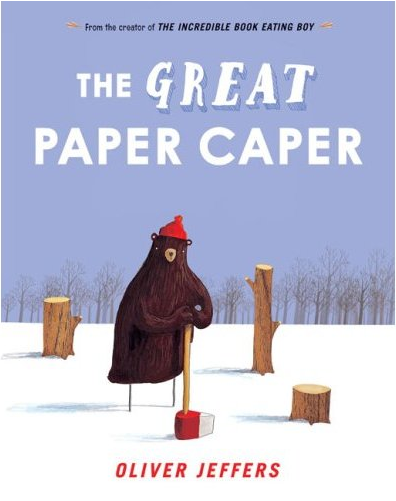
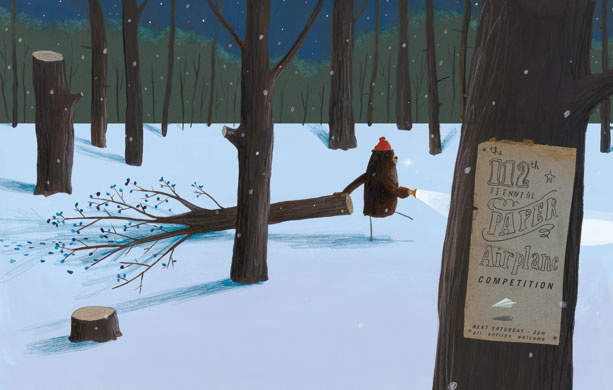
My favorite picture book artist, Oliver Jeffers, (I own all his books... and have no kids) put out a new book in January, called The Great Paper Caper. It's the story of a tree shortage in a forest that is ultimately accredited to a well-meaning but competitive grizzly-lookin' bear who just wanted to win the annual paper airplane contest. Perfectly illustrated, as always (Jeffers is also a working artist, whose paintings toy with the relationship between text and image-- swoon) the story utilizes a lot of great detective/police procedural vocabulary, not to mention to obvious conservation themes. And like The Incredible Book Eating Boy (also by Jeffers, winner of the Irish Children's Book Award) there are lots of clever little details in the backgrounds of the illustrations, though Incredible Book Eating Boy does not have anything quite like a pig making bacon as his alibi. Better for kids who are willing to have vocab words explained to them, this story did not do particularly well at my toddler-laden storytime. But nonetheless, I recommend it all the time, for ages 4 and 5 and up.


An Illustration from The Great Paper Caper

The Witness, a painting by Oliver Jeffers

Tuesday, April 14, 2009

I love you, man.


You'd think that working at a bookstore, I'd be at no loss for good books to read, but every once and a while I hit a slump, and the last few weeks have been just that. At first, I thought it was the books that I was reading (why can't they read my mind, and give me exactly what I want right this very second, even if I don't know what that is? gosh), but after a while I came to the conclusion that it was actually just me, being lazy, or being unwilling, or some such excuse. Whatever the case, I'd picked up and put down over 6 titles, and not for lack of trying with them, either.
But 3 of my coworkers have all been recommending City of Thieves by David Benioff (which is now in paperback) and I'm glad that I finally listened. It was exactly the quickly paced, escapist, pleasingly cinematic novel I needed to pull me out of my reading slump. And it's a great book to recommend to older teens, not just for its accessibility, but also since it's a strong, contemporary coming of age story. For those interested in WWII, it's a good choice, and accessible enough for reluctant readers.

After being arrested for looting the corpse of a German soldier, the narrator, Lev, is sent on a wild chicken chase with a charming deserter named Kolya to find a dozen eggs for a Soviet colonel's daughter's wedding cake. If they succeed, their lives are saved. If not, you get the idea. Their search takes them beyond Leningrad, and into enemy territory. In the mean time, the unlikely duo create an unexpectedly sentimental bond.
And it's possibly the most bromantic book I've ever read.
Though sometimes all the maleness of the novel got to me (if you don't have the equipment, it can be boring to peruse the manual) the friendship forged between the two main characters was always entertaining. Benioff certainly has a talent for writing clever exchanges, perfectly suited for film, if not always so in novel form. His dialog heavy style makes the book move along at a nice clip, and the plot does as well, with more intelligence than one expects from a page turner.
Benioff may not be ready to stand next to Vonnegut and Heller in the category of tragi-comic WWII stories, but he's certainly crafted an intensely entertaining novel, so good, it could pull my head out of my own
You get the idea.

Monday, April 6, 2009

my skirt is poofier than yours


The Luxe series, by Anna Godbersen, is my favorite not-really-guilty read to recommend to girls too smart for some of the more average mean girl fare. Though diction certainly does not define the intelligence of a novel, the language in all three installments of The Luxe is appropriately luxurious, particularly when providing lush descriptions of the clothes.
And the clothes. Set in 1899 New York, the ladies and gentlemen of this series are all lavishly dressed in true designer garb-- that is, articles made for one person only, for a high price by the very talented. (I felt very rewarded for having read Dana Thomas'
Deluxe: How Luxury Lost Its Luster, which is a non fiction work I'm a little disappointed in myself for not recommending to older, college bound teens.) However, changes in wardrobe have never been so menacing as in these winding tales of secrets, true love and jealousy. Great for lovers of historical fiction and romance, with outreach to those of us who are not necessarily bound by those two genres.