Showing posts with label dragons. Show all posts

Wednesday, May 19, 2010

Kids Classic I Forgot to Read: My Father's Dragon by Ruth Stiles Gannet

I've been slacking off lately, but since last August, I've been putting a "Kids' Classic I Forgot to Read" on our front desk for a month at a time. Previous titles are: From the Mixed-Up Files of Mrs Basil E Frankweiler, Egypt Game, Mrs. Frisby and the Rats of Nimh, Mr. Popper's Penguins, The Cricket in Times Square, A Wrinkle in Time and 13 Clocks. In honor of Fathers' Day, I decided to select My Father's Dragon by Ruth Stiles Gannet (illustrated by Ruth Chrisman Gannet), a fabulously wholesome story perfectly suited for reading aloud with the whole family. Little Elmer Elevator (the father of the faceless narrator) would give anything to fly. Luckily for him, he's made friends with an alley cat who knows where a dragon lives, held captive by a slew of wild animals. It is Elmer's quest to free the dragon, and chase his own dream of flying, and to do so he must use all his cunning, courage and (most of all) kindness to accomplish his goals. Elmer makes for a lovable protagonist, whose most memorable characteristics are that he is kind and he is clever. Though many of the animals want to eat him, he finds ways around them that do no harm to anyone. Win, win.
The illustrations are plentiful, and the type set is large, so the fact that it is 86 pages is a bit misleading. It's a very short story, similar in feel to many of the Japanese fairy tales I grew up reading (only with less tail-cutting-offness and swords). Simple enough for younger kids to follow, with all the adorable a grown-up can handle, I totally recommend this book for full family read alouds, barring the involvement of any snarky teens.
Shown above, an illustration of Elmer and his run in with the Rhino on Wild Island.

Friday, May 7, 2010

Gwen Millward's Drawings are Swell

Gwen Millward is a British illustrator who now lives in Bristol. You can check out what she has to say for herself at her website. Reviewed below are two very different stories, both illustrated by Millward.

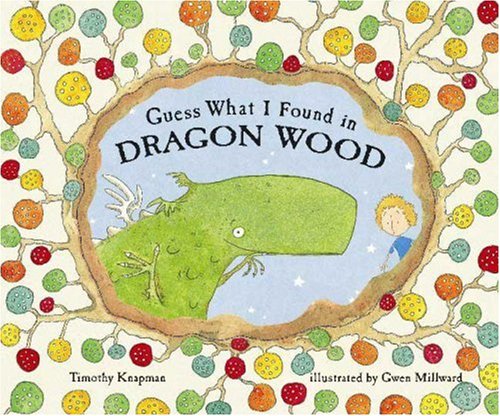
Guess What I Found in Dragonwood (written by Timothy Knapman) is the adorable story of a dragon who finds a Benjamin (human boy) in the forest, and promptly attempts to adopt him. He's shocked to find that Benjamin comes from a whole family of Benjamins, does not like to eat worms, and has the upsetting habit or crying rather than breathing fire. Millward's illustrations create a tactile and detailed landscape, complete with labels like "my favorite smoking volcano" and "this is a tear. It's a sad thing." The citrus palette for the dragon's home stands in pleasant contrast to the grays and blues of Benjamin's city, underlining the themes of difference and perspective nicely. Plus, it's a book that's got BOTH dragons AND soccer. Win, win.

Recently, we received The Bog Baby (written by Jeanne Willis) and I've been excited to handsell it since. The Bog Baby tells the story of two sisters who, when visiting a magic pond, capture a little blue, winged creature called a bog baby. Though they do everything they can to make the bog baby feel at home, they must ultimately release the delicate creature back into the pond where it belongs. It's a touching story about love and letting go, and Millward's delicately detailed illustrative style suits the tale perfectly. The full-page illustrations are breathtaking, capturing the magical sensibility of the story and illuminating it. The two page illustration of the bog baby being put back in his natural habitat is full of soft blues, lavendars and dusky pinks and shows the bog baby looking so pleased and happy that one cannot doubt that he's in the right place.

Thursday, March 19, 2009

requisite crazy feminist posting

I grew up watching this chick on TV (and then went to an all women's college), so I guess it's no surprise that I get a little kick out of YA novels that star tough, resourceful women who are never waiting for their prince to come save them. And sure, the tough grrrl fantasy card has been played a lot, and there's something troubling about having to look to universes populated by dragons and fairies and spaceships to find strong female role models, but that doesn't mean there aren't some great books with some kick-butt (mind your language, children) femmes that are totally worth reading. 2008 was a great year for strong women, too. So if you're looking to get beyond Lyra in Oxford, beyond Cimorene in the Enchanted Forest, beyond Tally Youngblood in Prettytown and LEAGUES beyond Bella in Forks, then here are some hardback titles that might be worth checking out:
Graceling, the debut novel from Kristin Cashore, is a must-read for Tamora Pierce graduates. Set in a fantastical, somewhat medieval world, the protagonist, Katsa, is one of the people who have what is called a grace, which is essentially just an extraordinary talent. Many people in this world have graces, but most are basically useless. Katsa's, however, is presented as a grace for killing people. Things get interesting when a dashing young man with his own mysterious grace is introduced, and Katsa begins to fall in love. One thing I really enjoyed about this novel, particularly amidst all the Twilight craziness, was that novel centers around a romantic relationship that thrives on the equality of the two people in love. Both are strong, both are talented, yet it is their separate strengths that compliment one another, creating a bond forged in mutual need (though, not dependence, and important distinction). I was also thrilled (thrilled) to find a sex scene in a fantasy novel in which birth control is used. It might seem silly to harp on such a small detail, but it was very contemporary moments like that, which steer Cashore clear of many fantasy novel cliches. It's also just refreshing to see sex presented as the perfect confluence of love and responsibility, not just as something that begets offspring. Kudos to Cory Doctorow, for using birth control in Little Brother, as well. The climactic battle against the evil king (yes, there's an evil king) is ultimately Katsa's battle, however, and she does it sans lover (who is hiding out in a cabin by himself as he goes blind, fighting his own battle). Though Katsa's narrative voice can be a little distant, it serves the complex plot of this very enjoyable story well, making it a great, escapist read.
I admit, I was reluctant, even after several glowing recommendations, to read Eon: Dragoneye reborn. Firstly, I have mostly departed the stage of my life in which dragons hold much interest. Secondly, the cover (which, upon reading the novel, I realized is actually perfect for the content) turned me off. Wrong I was. That's what I get for judging a book by it's cover, I suppose. It took me maybe about 50 pages to get into the novel, since the beginning is mostly descriptions of technical-sounding sword-fighting practice sequences. But as soon as I realized that this seemingly male narrator was suffering from 'moon cycles' I realized this was a much more interesting endeavor than I had given it credit for. From then on, I was hooked. Minimal dragons and maximum intrigue make the world of Eon one wrought with political skulduggery, personal vendettas and a full cast of eunuchs, drag queens and other such genderfull fun. And like the Bartimaeus Trilogy and Thirsty, it has the ending the story demands, depicting a very frank and terrifying apocalyptic coup d'etat. In the last hundred or so pages, I amended my previous assessment of age range on the book, due to the incredible graphic descriptions of beheaded corpses of friends, and the execution of a mother and her baby. It's not a direct line between the crowd that like Paolini's trilogy to Eon, but it may actually reach the less fantasy-genre inclined group of readers, which is really saying something for a book co-starring dragons.
Lastly, there was Hunger Games, the first book in what will be a trilogy, and already named NYT top 10 for 2008. Hunger Games is a perfectly paced, thrilling read, perfectly suited for voracious and reluctant readers alike. The plot moves ahead at breakneck speed, but it is the socio-economic commentary that really make this novel interesting. In the post-apocalyptic world of Hunger Games, 24 children are selected by lottery every year from the 12 different districts to fight to the death. The wealthy districts can afford to train their kids, and so it is typically those districts who prevail in the fights. The poorest districts, such as the agricultural district and the coal-mining district (where the novel's heroine, Katniss hails from) almost always lose. But Katniss refuses to go so easily, and her fight for survival is a riveting read that, like Eon, sets up for the next book perfectly. As she fights, more is learned about the different districts, and Collins' depiction of the agricultural district asks particular pertinent questions about many of the industrialized agricultural industries that set our tables. And it seems like every kid I've turned this on to comes back to the store with that crazy look in their eye, asking when the next installment will come out. Like my kid reviewer Gabe aptly wrote: "If you like books about kids fighting to the death, then this is the book for you." Right you are Gabe, right you are.