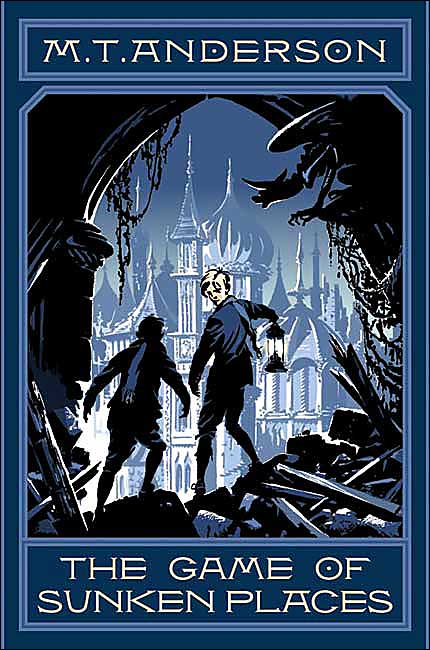
 Though I have yet to hit my stride with the perfect kid to recommend this book to, The Game of Sunken Places is still one of my favorite handsells for anyone who will listen to me. Two, odd couple friends get sucked into a game somewhat akin to Jumanji, minus the safari animals and psychotic hunter, but plus a troll going through an existential crisis. They eventually realize they are being pitted against one another, and it is a touching moment when their friendship and teamwork prevails. I think this was the third book I read by Anderson, but I know this is when my appreciation for him really began to materialize. Here, in this old school adventure story, Anderson is able to depict a very real friendship in a very unreal situation, and toss in secondary characters who beg the question of whether or not the capacity to recall makes someone real. The dialogue in this book is fantastic, and the exchanges between the two boys are particularly well handled. Anderson doesn't just write for smart kids, but he writes about them too.
So, the one time I got to meet MT Anderson, at the super cool Not Your Mother's Book Club ( more information about NYMBC available at the following link: http://www.notyourmothersbookclub.com/Welcome.html) the crazy slick thing I managed to squeak out when I made MT Anderson sign EVERY SINGLE ONE of his books (I was told not to be embarrassed about this, but, well, c'mon, I even had the picture books) I said: Hey, did you know when you say MT out loud, it sounds like empty? Yeah, because I'm super cool like that. But he very graciously played along with the joke (which wasn't even my joke, it was my coworker Bob's) and told me that he and his editor used to laugh at the notion that his first YA book, Thirsty, was by someone named empty.
Thirsty is Anderson's vampire book, in what I can only assume is his quest to conquer every genre. And amidst what I will only refer to as the promise-ring-vampires, it was refre shing to find this intelligent, non-lovey-dovey-icky-sticky vampire story to recommend to the reader looking for VAMPIRES, real vampires, scary, blood-drinking vampires. It's one of those books I wish existed when I was twelve, (which is when I went through my vampire faze) because this would have been an easy favorite. Like any good horror movie, Anderson moves deftly between truly scary moments and relieving humor. In this world of vampires, people do not necessarily become vampires because they are bitten, since some, like the protagonist of this story, become a vampire during puberty. Talk about the horrors of adolescence. And to kick it off, right at the beginning of the story, we are witness to a vampire lynching (yes, that's Anderson's word choice) and to news reports of a mother killing her baby twins since one of them was something un-human. So even in his vampire story, Anderson finds ways to ask questions about the society we live in. But what really impressed me about this book was the ending, which I will not ruin here. Since one of my major complaints about kids books is that often authors will pull punches and tack on a happy ending so as not to hurt the fragile minds of the children (won't somebody PLEASE think of the children?) Anderson, by contrast, wrote the ending that the story demanded.
 shing to find this intelligent, non-lovey-dovey-icky-sticky vampire story to recommend to the reader looking for VAMPIRES, real vampires, scary, blood-drinking vampires. It's one of those books I wish existed when I was twelve, (which is when I went through my vampire faze) because this would have been an easy favorite. Like any good horror movie, Anderson moves deftly between truly scary moments and relieving humor. In this world of vampires, people do not necessarily become vampires because they are bitten, since some, like the protagonist of this story, become a vampire during puberty. Talk about the horrors of adolescence. And to kick it off, right at the beginning of the story, we are witness to a vampire lynching (yes, that's Anderson's word choice) and to news reports of a mother killing her baby twins since one of them was something un-human. So even in his vampire story, Anderson finds ways to ask questions about the society we live in. But what really impressed me about this book was the ending, which I will not ruin here. Since one of my major complaints about kids books is that often authors will pull punches and tack on a happy ending so as not to hurt the fragile minds of the children (won't somebody PLEASE think of the children?) Anderson, by contrast, wrote the ending that the story demanded.
And now, the real gushing begins. It's hard to say that I have a favorite among Anderson's books. I really do love them all. But Feed is certainly the novel that has  had the most effect on the way I think on a daily basis. It's hard not to look at the iPhone, (for which there are applications you download so that if you simply point your it at something that is playing a song you like, and it will immediately connect you to that song on iTunes so you can buy it) and feel like Anderson saw this all coming. Feed is a novel that eloquently (though in a manner and voice that feels legitimately teen aged) questions the relationship between consumerism and technology, and what very negative outcomes that could have on the future of autonomy and our ability to create real connections with one another. As the protagonist, Titus, explains: "...the weirdest thing is that you know you're more alone than anyone , but that people are thinking about you more than ever before. They're all just there, holding their breath, watching you're every move...So you're more alone, but more watched" (Anderson, 195). It's a book I love to handsell, not only because invariably, kids come back with wide eyes, telling me how cool that book was, but because it's one I could see making a difference in the way that future generations look at the cross section of consumerism and technology.
had the most effect on the way I think on a daily basis. It's hard not to look at the iPhone, (for which there are applications you download so that if you simply point your it at something that is playing a song you like, and it will immediately connect you to that song on iTunes so you can buy it) and feel like Anderson saw this all coming. Feed is a novel that eloquently (though in a manner and voice that feels legitimately teen aged) questions the relationship between consumerism and technology, and what very negative outcomes that could have on the future of autonomy and our ability to create real connections with one another. As the protagonist, Titus, explains: "...the weirdest thing is that you know you're more alone than anyone , but that people are thinking about you more than ever before. They're all just there, holding their breath, watching you're every move...So you're more alone, but more watched" (Anderson, 195). It's a book I love to handsell, not only because invariably, kids come back with wide eyes, telling me how cool that book was, but because it's one I could see making a difference in the way that future generations look at the cross section of consumerism and technology.On a side note, it's also the only time the afterward with an author has made me teary eyed:"You already think in ways I'll never be capable of, and are dreaming things I can't conceive of. Keep it up. We're counting on you."
There is only one of Anderson's chapter books I haven't written about, and that's Burger Wuss. The reason for that is, simply, because I haven't read it yet! I'm saving it for sometime when, inevitably, I'll have read a stretch of not-so-good books, and I'll need something good and new to cleanse the palate. But that is, basically, what is the coolest thing about MT Anderson. You can always depend on him for a good, smart book.