So one my fellow students in the USF MFA program has a website! Mary wants to write for kids too, and reads way more than I do. So for more on all things kid lit, go to this link:
http://kidlit.com/
She has contests, so, you know. Go there.
Wednesday, April 29, 2009


Good grief.
So, I admit that things like seeing the crew from San Francisco getting eliminated on America's Best Dance Crew have made me cry. Once, a Campbell's soup commercial. It's true. So maybe it's fair to say it doesn't take much to make me cry. I'm a sucker. But, at the very least, I like to think I can tell when I've been sucker punched. And there are some things that earn the tears.
I recently read the new YA novel, If I Stay, by Gayle Foreman, and cried and cried and cried and cried and then cried some more until my face hurt. It's about a girl named Mia who begins an out of body experience after she suffers a horrific car accident with her family. Her parents are dead on the scene, and her believably adorable younger brother is whisked away. The novel moves back in forth between the times before the accident, and after. What I found really compelling was the handling of the out of body conceit. Mia's body is comatose in the present action of the novel, and her spirit, her consciousness (or however you want to describe it) bears witness to visitations from her extended family, friends, and boyfriend.
When I was told what the conceit was, I had my reservations; it sounded a little Lovely Bonesish to me, and I seem to be the only person in the world who did not like that novel. But Foreman handles it elegantly, believably and most of all evocatively. The family and friends that create Mia's emotional landscape are empathetically and realistically portrayed. And while they are incredibly specific (a dad who used to love punk and now loves bow ties, for example) they also feel authentically universal in the love that binds them to one another. So while Mia struggles to decide between life with the crippling pain of losing her family and something that may be much easier, the reader is invited to look for moments of love in their own life.
And so even though the novel centers around the absolute worst-case scenario of family loss, it is ultimately a celebration the things that make life worth living. And so I cried and I cried and I cried and then I cried some more while I thinking about it later.
I recently read the new YA novel, If I Stay, by Gayle Foreman, and cried and cried and cried and cried and then cried some
 more until my face hurt. It's about a girl named Mia who begins an out of body experience after she suffers a horrific car accident with her family. Her parents are dead on the scene, and her believably adorable younger brother is whisked away. The novel moves back in forth between the times before the accident, and after. What I found really compelling was the handling of the out of body conceit. Mia's body is comatose in the present action of the novel, and her spirit, her consciousness (or however you want to describe it) bears witness to visitations from her extended family, friends, and boyfriend.
When I was told what the conceit was, I had my reservations; it sounded a little Lovely Bonesish to me, and I seem to be the only person in the world who did not like that novel. But Foreman handles it elegantly, believably and most of all evocatively. The family and friends that create Mia's emotional landscape are empathetically and realistically portrayed. And while they are incredibly specific (a dad who used to love punk and now loves bow ties, for example) they also feel authentically universal in the love that binds them to one another. So while Mia struggles to decide between life with the crippling pain of losing her family and something that may be much easier, the reader is invited to look for moments of love in their own life.
And so even though the novel centers around the absolute worst-case scenario of family loss, it is ultimately a celebration the things that make life worth living. And so I cried and I cried and I cried and then I cried some more while I thinking about it later.
Saturday, April 18, 2009
oh mr. jeffers, you're so dreamy.
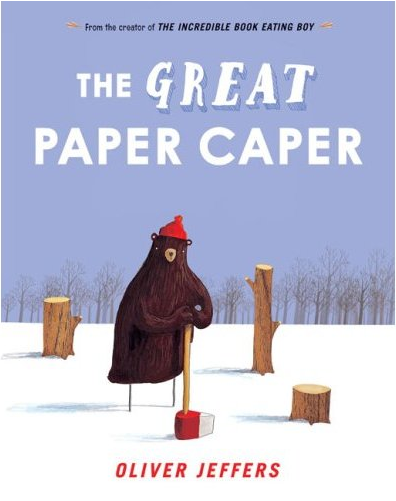
My favorite picture book artist, Oliver Jeffers, (I own all his books... and have no kids) put out a new book in January, called The Great Paper Caper. It's the story of a tree shortage in a forest that is ultimately accredited to a well-meaning but competitive grizzly-lookin' bear who just wanted to win the annual paper airplane contest. Perfectly illustrated, as always (Jeffers is also a working artist, whose paintings toy with the relationship between text and image-- swoon) the story utilizes a lot of great detective/police procedural vocabulary, not to mention to obvious conservation themes. And like The Incredible Book Eating Boy (also by Jeffers, winner of the Irish Children's Book Award) there are lots of clever little details in the backgrounds of the illustrations, though Incredible Book Eating Boy does not have anything quite like a pig making bacon as his alibi. Better for kids who are willing to have vocab words explained to them, this story did not do particularly well at my toddler-laden storytime. But nonetheless, I recommend it all the time, for ages 4 and 5 and up.
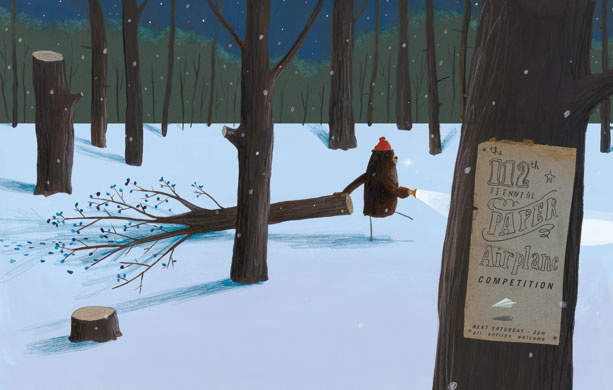
An Illustration from The Great Paper Caper
 The Witness, a painting by Oliver Jeffers
Tuesday, April 14, 2009
I love you, man.

You'd think that working at a bookstore, I'd be at no loss for good books to read, but every once and a while I hit a slump, and the last few weeks have been just that. At first, I thought it was the books that I was reading (why can't they read my mind, and give me exactly what I want right this very second, even if I don't know what that is? gosh), but after a while I came to the conclusion that it was actually just me, being lazy, or being unwilling, or some such excuse. Whatever the case, I'd picked up and put down over 6 titles, and not for lack of trying with them, either.
But 3 of my coworkers have all been recommending City of Thieves by David Benioff (which is now in paperback) and I'm glad that I finally listened. It was exactly the quickly paced, escapist, pleasingly cinematic novel I needed to pull me out of my reading slump. And it's a great book to recommend to older teens, not just for its accessibility, but also since it's a strong, contemporary coming of age story. For those interested in WWII, it's a good choice, and accessible enough for reluctant readers.
After being arrested for looting the corpse of a German soldier, the narrator, Lev, is sent on a wild chicken chase with a charming deserter named Kolya to find a dozen eggs for a Soviet colonel's daughter's wedding cake. If they succeed, their lives are saved. If not, you get the idea. Their search takes them beyond Leningrad, and into enemy territory. In the mean time, the unlikely duo create an unexpectedly sentimental bond.
And it's possibly the most bromantic book I've ever read.
Though sometimes all the maleness of the novel got to me (if you don't have the equipment, it can be boring to peruse the manual) the friendship forged between the two main characters was always entertaining. Benioff certainly has a talent for writing clever exchanges, perfectly suited for film, if not always so in novel form. His dialog heavy style makes the book move along at a nice clip, and the plot does as well, with more intelligence than one expects from a page turner.
Benioff may not be ready to stand next to Vonnegut and Heller in the category of tragi-comic WWII stories, but he's certainly crafted an intensely entertaining novel, so good, it could pull my head out of my own
You get the idea.
But 3 of my coworkers have all been recommending City of Thieves by David Benioff (which is now in paperback) and I'm glad that I finally listened. It was exactly the quickly paced, escapist, pleasingly cinematic novel I needed to pull me out of my reading slump. And it's a great book to recommend to older teens, not just for its accessibility, but also since it's a strong, contemporary coming of age story. For those interested in WWII, it's a good choice, and accessible enough for reluctant readers.
After being arrested for looting the corpse of a German soldier, the narrator, Lev, is sent on a wild chicken chase with a charming deserter named Kolya to find a dozen eggs for a Soviet colonel's daughter's wedding cake. If they succeed, their lives are saved. If not, you get the idea. Their search takes them beyond Leningrad, and into enemy territory. In the mean time, the unlikely duo create an unexpectedly sentimental bond.
And it's possibly the most bromantic book I've ever read.
Though sometimes all the maleness of the novel got to me (if you don't have the equipment, it can be boring to peruse the manual) the friendship forged between the two main characters was always entertaining. Benioff certainly has a talent for writing clever exchanges, perfectly suited for film, if not always so in novel form. His dialog heavy style makes the book move along at a nice clip, and the plot does as well, with more intelligence than one expects from a page turner.
Benioff may not be ready to stand next to Vonnegut and Heller in the category of tragi-comic WWII stories, but he's certainly crafted an intensely entertaining novel, so good, it could pull my head out of my own
You get the idea.
Monday, April 6, 2009
my skirt is poofier than yours

The Luxe series, by Anna Godbersen, is my favorite not-really-guilty read to recommend to girls too smart for some of the more average mean girl fare. Though diction certainly does not define the intelligence of a novel, the language in all three installments of The Luxe is appropriately luxurious, particularly when providing lush descriptions of the clothes.
And the clothes. Set in 1899 New York, the ladies and gentlemen of this series are all lavishly dressed in true designer garb-- that is, articles made for one person only, for a high price by the very talented. (I felt very rewarded for having read Dana Thomas' Deluxe: How Luxury Lost Its Luster, which is a non fiction work I'm a little disappointed in myself for not recommending to older, college bound teens.) However, changes in wardrobe have never been so menacing as in these winding tales of secrets, true love and jealousy. Great for lovers of historical fiction and romance, with outreach to those of us who are not necessarily bound by those two genres.
And the clothes. Set in 1899 New York, the ladies and gentlemen of this series are all lavishly dressed in true designer garb-- that is, articles made for one person only, for a high price by the very talented. (I felt very rewarded for having read Dana Thomas' Deluxe: How Luxury Lost Its Luster, which is a non fiction work I'm a little disappointed in myself for not recommending to older, college bound teens.) However, changes in wardrobe have never been so menacing as in these winding tales of secrets, true love and jealousy. Great for lovers of historical fiction and romance, with outreach to those of us who are not necessarily bound by those two genres.
Thursday, March 26, 2009
bad mood city

Big Rabbit's Bad Mood has got to be my favorite picture book of the new year. It embodies exactly what makes picture books fun, with simple (yet detailed) and surprisingly sophisticated illustrations with a clever story of Big Rabbit, who is being followed around by his bad mood. The bad mood is a bigfoot-lookin' creature with orangutan-length arms, who does things like eat the radio, knock things over and wipe his boogers on the floor. I read this story at storytime last Saturday, and we actually couldn't move forward from the booger moment because all the kids were laughing so hard. It's the perfect length for read-aloud when one is dealing with a variety of ages, since the concept is simple, but the execution works on several levels. And, for all the simplicity of the illustrations, it is incredibly evocative. Big Rabbit's face expresses a spectrum of emotion, from ennui to elation. Not to mention the bad mood, whose facial expressions are hilariously hedonistic (he really likes to eat things, like the radio and cacti). Ultimately, the bad mood makes a silent exit when Big Rabbit's friends all show up for his suprise birthday. Even his mommy, complete with pancake-cake, is in attendance. Perfect for kids, but fun for adults, just the way picture books ought to be.
Thursday, March 19, 2009
requisite crazy feminist posting
 I grew up watching this chick on TV (and then went to an all women's college), so I guess it's no surprise that I get a little kick out of YA novels that star tough, resourceful women who are never waiting for their prince to come save them. And sure, the tough grrrl fantasy card has been played a lot, and there's something troubling about having to look to universes populated by dragons and fairies and spaceships to find strong female role models, but that doesn't mean there aren't some great books with some kick-butt (mind your language, children) femmes that are totally worth reading. 2008 was a great year for strong women, too. So if you're looking to get beyond Lyra in Oxford, beyond Cimorene in the Enchanted Forest, beyond Tally Youngblood in Prettytown and LEAGUES beyond Bella in Forks, then here are some hardback titles that might be worth checking out:
 Graceling, the debut novel from Kristin Cashore, is a must-read for Tamora Pierce graduates. Set in a fantastical, somewhat medieval world, the protagonist, Katsa, is one of the people who have what is called a grace, which is essentially just an extraordinary talent. Many people in this world have graces, but most are basically useless. Katsa's, however, is presented as a grace for killing people. Things get interesting when a dashing young man with his own mysterious grace is introduced, and Katsa begins to fall in love. One thing I really enjoyed about this novel, particularly amidst all the Twilight craziness, was that novel centers around a romantic relationship that thrives on the equality of the two people in love. Both are strong, both are talented, yet it is their separate strengths that compliment one another, creating a bond forged in mutual need (though, not dependence, and important distinction). I was also thrilled (thrilled) to find a sex scene in a fantasy novel in which birth control is used. It might seem silly to harp on such a small detail, but it was very contemporary moments like that, which steer Cashore clear of many fantasy novel cliches. It's also just refreshing to see sex presented as the perfect confluence of love and responsibility, not just as something that begets offspring. Kudos to Cory Doctorow, for using birth control in Little Brother, as well. The climactic battle against the evil king (yes, there's an evil king) is ultimately Katsa's battle, however, and she does it sans lover (who is hiding out in a cabin by himself as he goes blind, fighting his own battle). Though Katsa's narrative voice can be a little distant, it serves the complex plot of this very enjoyable story well, making it a great, escapist read.
I admit, I was reluctant, even after several glowing recommendations, to read Eon: Dragoneye reborn. Firstly, I have mostly departed the stage of my life in w hich dragons hold much interest. Secondly, the cover (which, upon reading the novel, I realized is actually perfect for the content) turned me off. Wrong I was. That's what I get for judging a book by it's cover, I suppose. It took me maybe about 50 pages to get into the novel, since the beginning is mostly descriptions of technical-sounding sword-fighting practice sequences. But as soon as I realized that this seemingly male narrator was suffering from 'moon cycles' I realized this was a much more interesting endeavor than I had given it credit for. From then on, I was hooked. Minimal dragons and maximum intrigue make the world of Eon one wrought with political skulduggery, personal vendettas and a full cast of eunuchs, drag queens and other such genderfull fun. And like the Bartimaeus Trilogy and Thirsty, it has the ending the story demands, depicting a very frank and terrifying apocalyptic coup d'etat. In the last hundred or so pages, I amended my previous assessment of age range on the book, due to the incredible graphic descriptions of beheaded corpses of friends, and the execution of a mother and her baby. It's not a direct line between the crowd that like Paolini's trilogy to Eon, but it may actually reach the less fantasy-genre inclined group of readers, which is really saying something for a book co-starring dragons.
 hich dragons hold much interest. Secondly, the cover (which, upon reading the novel, I realized is actually perfect for the content) turned me off. Wrong I was. That's what I get for judging a book by it's cover, I suppose. It took me maybe about 50 pages to get into the novel, since the beginning is mostly descriptions of technical-sounding sword-fighting practice sequences. But as soon as I realized that this seemingly male narrator was suffering from 'moon cycles' I realized this was a much more interesting endeavor than I had given it credit for. From then on, I was hooked. Minimal dragons and maximum intrigue make the world of Eon one wrought with political skulduggery, personal vendettas and a full cast of eunuchs, drag queens and other such genderfull fun. And like the Bartimaeus Trilogy and Thirsty, it has the ending the story demands, depicting a very frank and terrifying apocalyptic coup d'etat. In the last hundred or so pages, I amended my previous assessment of age range on the book, due to the incredible graphic descriptions of beheaded corpses of friends, and the execution of a mother and her baby. It's not a direct line between the crowd that like Paolini's trilogy to Eon, but it may actually reach the less fantasy-genre inclined group of readers, which is really saying something for a book co-starring dragons.
Lastly, there was Hunger Games, the first book in what will be a trilogy, and already named NYT top 10 for 2008. Hunger Games is a perfectly paced, thrilling read, perfectly suited for voracious and reluctant readers alike. The plot moves ahead at breakneck speed, but it is the socio-economic  commentary that really make this novel interesting. In the post-apocalyptic world of Hunger Games, 24 children are selected by lottery every year from the 12 different districts to fight to the death. The wealthy districts can afford to train their kids, and so it is typically those districts who prevail in the fights. The poorest districts, such as the agricultural district and the coal-mining district (where the novel's heroine, Katniss hails from) almost always lose. But Katniss refuses to go so easily, and her fight for survival is a riveting read that, like Eon, sets up for the next book perfectly. As she fights, more is learned about the different districts, and Collins' depiction of the agricultural district asks particular pertinent questions about many of the industrialized agricultural industries that set our tables. And it seems like every kid I've turned this on to comes back to the store with that crazy look in their eye, asking when the next installment will come out. Like my kid reviewer Gabe aptly wrote: "If you like books about kids fighting to the death, then this is the book for you." Right you are Gabe, right you are.
 commentary that really make this novel interesting. In the post-apocalyptic world of Hunger Games, 24 children are selected by lottery every year from the 12 different districts to fight to the death. The wealthy districts can afford to train their kids, and so it is typically those districts who prevail in the fights. The poorest districts, such as the agricultural district and the coal-mining district (where the novel's heroine, Katniss hails from) almost always lose. But Katniss refuses to go so easily, and her fight for survival is a riveting read that, like Eon, sets up for the next book perfectly. As she fights, more is learned about the different districts, and Collins' depiction of the agricultural district asks particular pertinent questions about many of the industrialized agricultural industries that set our tables. And it seems like every kid I've turned this on to comes back to the store with that crazy look in their eye, asking when the next installment will come out. Like my kid reviewer Gabe aptly wrote: "If you like books about kids fighting to the death, then this is the book for you." Right you are Gabe, right you are.
Subscribe to:
Posts (Atom)