Showing posts with label Newbery Award Winner. Show all posts

Sunday, November 28, 2010

Things 2nd Grade Boys like

Since I abandoned this blog to the cold winds of internet neglect, I've started officiating some book clubs for kids. One of them is a group of 2nd grade boys who vary wildly in reading level, so aside from the fact that planning a discussion for a handful of 8 year old boys is kind of like trying to choreograph cat herding, we also struggle to find books that every one can relate to. Below, are the books we've read so far.

I started us off with The Iron Giant by Ted Hughes. It was originally titled The Iron Man: A Story in 5 Nights, but the title was changed when the superhero superceded Hughes' novel in popularity. Now there's a movie, which is AMAZING and every one should watch it, but is totally different than the book. And even if you've seen the movie (which I agree, is awesome) you should still read the book and hopefully you'll like it even a fraction as much as this group of boys did. I started off the discussion simply, by asking what their favorite parts were. The boys then clamored with their answers, revisions to their answers and dramatic readings of their scenes of choosing. It was the perfect book to get us started. Fun, simple, full of startling and direct symbolic imagery, The Iron Giant is a great book for reluctant readers obsessed with Star Wars and the kids who can already read Harry Potter (with a parent). I decided NOT to bring up the fact that Hughes wrote it to comfort his children after his wife, Sylvia Plath, had a run in with her oven.
the current edition since changing publishers
 Second, we read Whales on Stilts by MT Anderson, the first in the Pals in Peril series (previously called MT Anderson's Thrilling Tales). Anyone who's listened to me blather about books knows that MT Anderson's basically my favorite, and I was really excited to have a chance to force his book on a bunch of kids subjected to my literary whims. Unfortunately, the sense of humor was a little beyond a few of our readers, and while we still managed to have a lively discussion rich with dramatic readings we also spent a lot of time clarifying vocabulary and plot points for some. Jasper Dash's character, particularly, who speaks in a hilariously outdated vernacular, left some of group behind. But I was really pleased to find that the kids who could keep up with Jasper and his chums loved the book, and took to the absurdity nicely. One of the readers has even continued on with the series on his own, and had already completed the second book by the time we met. And, being the group's only Jew, I was pleased to explain what gefilte fish is to the general disgust of all our members.
the new cover, which no longer features Peter Sis's illustrations
Despite the horror most of the mothers expressed to me over the title, I still assigned Sid Fleishman's Newbery Winner, The Whipping Boy. Though it was a struggle to get the boys to focus on this particular meeting date, we still managed to get some of the most insightful discussion we've ever had from this book. Toward the end of our discussion I asked if the boys could think of any examples in which, like in the book, someone or something is punished for misdeeds committed by another. Initially many examples of wrongful accusations among siblings and household pets were offered, but eventually one boy gave the following example, which I thought was not only apt, but very thoughtful: "It's like," he said "when someone lets go of a balloon, and they think it's really funny to watch it float away, but then eventually it pops and it lands in the ocean, and then a turtle eats it, because it thinks it's a jellyfish, but it's not. And then the turtle suffocates and dies."

Up Next:
For January

For February

Friday, January 8, 2010

Mrs. Frisby and the Rats of Nimh by Robert C. Obrien

Winner of the 1972 Newbery Medal, Mrs Frisby and the Rats of Nimh, from the author of Z for Zachariah and The Silver Crown, is a thoroughly imagined tale of mice, medication, and one of the toughest moms in all of kids' lit. Mrs. Frisby is a widow, with four small children, one of whom is gravely ill. In order to keep her son Timothy alive, she must contract the help of the rats of NIMH, former lab rats who, after being subjected to steroids, tests, captivity and other such calamities, escape into the countryside. It is not long before it is revealed that Mr. Frisby was the only suriviving mouse for said experiments. Mrs. Frisby, who is not gifted as the rats are or her husband was, braves owls, cats and rat poison in the name of familial love. What I found most striking about this book was the complexity of the rats' world. Though talking rats and mice and crows and shrews do not exist, the world they inhabit in this novel comes across as completely reasonable, and the tests the rats describe have a surprisingly element of realism. Perfectly suited for reading aloud with the whole family, (with a few slyly funny moments, to boot) this book was a pleasure to reread. It was also made into an awesome movie in 1982, entitled The Secret of Nimh.

Sunday, October 18, 2009

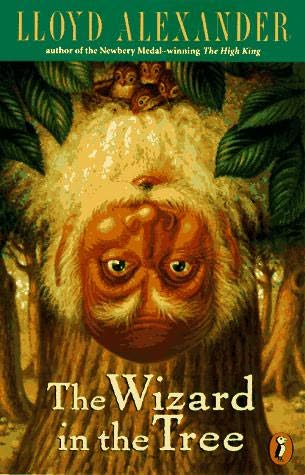
The Wizard in the Tree by Lloyd Alexander

If you're a kid (or adult) who hasn't read Lloyd Alexander's Prydain Chronicles (Newbery Honor for the second book, The Black Cauldron and Newbery Winning for the High King , a series starting with The Book of Three) do it. Sure, it's kind of a Lord of the Rings knockoff for kids, but Alexander's ear for poetry in prose is undeniable, and perfectly suited for children's literature. I loved those books as a kids, and as an adult, reread (sort of... I never really read it in the first place, but knew the plot of all three books since my sister told me the stories so many times I might as well have read them) the Westmark Trilogy, a fabulous trilogy about a revolution from the books up.
So when I found this odd title, The Wizard in the Tree, at my favorite used bookstore in the bay area (Dark Carnival, go guys go) I had to read it. And while it was not quite as good as some of Alexander's other, more famous work, it was still an incredibly enjoyable read, perfect for middle grade readers in the middle of the pack, ages 8 to 12. At times funny, others violent (there are some murders), this book creates a wonderful anti-Potter definition of the true nature of magic, with some clever environmentalist themes that make it timely, even if it is the silly story of a little girl who finds a wizard in a tree.
Complete with plucky heroine, curmudgeonly wizard, and eeeevil (yes, so evil he's eeeevil) squire, The Wizard in the Tree is a clever story from a very clever author, whose breadth of work I am just beginning to appreciate.

And seriously, read the Prydain Chronicles, and its awesome companion book of short stories, The Foundling. Awesome.

Monday, October 5, 2009

The Whipping Boy by Sid Fleischman

The Newbery Winner of 1987 (and illustrated by the great Peter Sis) The Whipping Boy was a surprisingly funny read, complete with dancing bear, blundering con men and a bratty prince with an untapped heart. Even kids who are not necessarily interested in historical fiction will find points of interest in this book. The story is told from the perspective of the prince's whipping boy, an orphan named Jemmy. If you, like me, before I read this book, have no idea what a whipping boy is, it's a designated person to suffer punishments on the prince's behalf. Since the prince in this tale is rotten, Jemmy takes many whippings, a fact the prince cares about very little. When they run away together, Prince Brat (as he is also called) begins to learn the errors of his ways, and he and Jemmy strike up an unlikely friendship. At 89 pages long, even more reluctant readers will be unafraid to pick up this absurd little tale of empathy, trust and friendship. Perfect for early readers making the transition to chapter books, with a pleasantly snarky narrative voice.

Tuesday, June 23, 2009

The Magician's Elephant by Kate DiCamillo

Everyone loves the Newbery Winner, The Tale of Despereaux. Loves it. I only liked it. It was cute of course, and DiCamillo's narrative voice carried me immediately to that safe, story time place that makes me feel like I'm six years old again. But I thought that it did more to reinforce classism than much else, and as a result I was only lukewarm on it. Of course, I'm literally the only person in the entire literary universe who seems to feel that way.

But DiCamillo's new book, The Magician's Elephant, was something else entirely. I again was taken to that safe, story time place. But this time, I felt DiCamillo used her allegorical style to its fullest, and I found myself in tears by the end of it.

When a magician conjures and elephant (and then is unable to send it back from whence it came) that comes crashing through a theater ceiling, everyone in the tiny town's life seems to change. Soon, the elephant is at the center of the social, moral, spiritual and dream world of everyone in the town. And as the townspeople learn the accept the possibility of the impossible, many of the citizens begin to pin their many assorted impossible dreams on the elephant.

Heartwarming and perfect for family read aloud, I loved The Magician's Elephant the same way I love The Little Prince, one of my all-time favorite children's novels. If there were a book I could force on everyone this fall, I think this would be my choice.

Read it.

The Westing Game by Ellen Raskin

The next stop on the Newbery Challenge was the 1978 winner, The Westing Game. A multi-perspectival mystery that centers around a (possibly) deceased man's will, Raskin represents the American melting pot in a way that ages surprisingly well for something written in the late 70's. Clever, and by turns hilarious, the whole time I was reading the Westing Game, I kept thinking how much the scores of kids who love Trenton Stewart's Mysterious Benedict Society would like this book. In fact, I could not help but wonder if perhaps Stewart had been inspired by the character of Turtle (from the Westing Game) when writing his own petite contrarian, Constance.
What I liked best about this novel was when, about 2/3 of the way through, I thought I had the mystery entirely solved, only to find that Raskin had not only anticipated my solution but also debunked it, carrying the mystery into deeper, more interesting territory. Not to mention the fact that it's probably the most patriotic kid's book I've ever liked.
For ages eight and up, and adults who like a little wholesome fun, The Westing Game was very much deserving of its medal.

Saturday, June 6, 2009

Cool Hand Magee

The next installment of my Newbery Challenge was Maniac Magee by Jerry Spinelli, the 1991 Newbery Winner. The lyrical and rhythmic narrative voice of this piece lent itself to an aural effect that fit the content of the story well. Maniac Magee, a little boy who's been running away (from home, from places that are almost home, and places that never felt like home in the first place) and in the meantime cultivates a hero-like mythology about him.
Though the entire book was well-written and enjoyable, my absolute favorite section was when Maniac starts living with Grayson, an old caretaker of the zoo and baseball field. When it turns out that Grayson was a minor league pitcher, he and Magee start to swap baseball advice for reading lessons (Grayson is illiterate). It was an incredibly emotional passage, and the descriptions of Grayson's old, leather baseball glove struck a chord with me particularly.
Though race is a central theme throughout this entire novel, Spinelli steers clear of familiar tropes, and the characters of this world are well rounded and believable. It made me wonder though, how much of this really feels fresh anymore. There are so many books written for kids about white people and black people learning to accept each other's humanity (Newbery Winner, Roll of Thunder Hear My Cry, for example), that at some point it begins to feel stale and didactic no matter how good the writing is. Of course, as my coworker Rich so aptly pointed out, I come from a very liberal, Bay Area racial education, and that my perspective on the matter is not typical country wide. He's right of course, but because I primarily deal with kids with a similar background to me, I wonder how well a book like this will hold up with that crowd.
It heartens me that the only way to find that out is to recommend it to as many kids as I can.


Saturday, May 30, 2009

The Newbery Challenge continues...

So the internet has been down at my house for the last week... but in that time I read three Newbery Winners that I would break into two categories: fun and edifying. While all three were well written, only one really caught my attention as the type of book that would be fun for kids. The other two I could see having more value for teachers, and would make the best kind of homework.

The first, the 1930 Newbery Winner,
The Cat Who Went to Heaven by Elizabeth Coatsworth, is essentially an introduction to Buddhism for children. It's the story of an artist in Japan who is commissioned by a temple to paint the death of Buddha, a scene which includes a wide variety of animals. When his housekeeper picks up a stray cat, despite the fact that household can hardly afford another mouth to feed, the artist unwittingly begins his journey to a new understanding of the Buddha. As he paints each animal, he considers the various traits they each represent, and searches to see honor in them all. Meanwhile, he becomes closer to his cat. And though cats did not visit the Buddha when he died, he ultimately decides to include one in the painting, causing his pet to die of happiness. Beautifully written, and pleasantly concise, The Cat Who Went to Heaven is a great book for parents who want their younger children to learn about Buddhism, though may not be a good choice for reluctant readers, or readers looking for adventure in their stories.

The Twenty-One Balloons, by William Pene DuBois, on the other hand is a fantastically fun read with enough hot air-balloon travel and explosions for any reader. It won the Newbery in 1948, and is the story of a San Francisco math teacher who decides to escape his boring life in lieu of a hot air balloon adventure. When he crash lands on the Pacific Island of Krakatoa, a paradise laden with diamonds, he encounters a strange, utopian society of former San Francisco residents. And though Krakatoa is a volatile volcano, the residents have an escape plan. A clever tale with humor to spare, The Twenty-One Balloons was a pleasure to read, with fantastic illustrations by the author. It would be well suited for a family read aloud with younger kids, as it's an entirely wholesome tale and all the air travel a reader can handle.

The 1996 Newbery Winner, The Midwife's Apprentice, by Karen Cushman is a story of self-realization, packed with wonderful historical details. The realities of childbrith in
middle ages are hardly sugar-coated, and while it is an incredibly
short book (128 pages) it is hardly suited for readers younger than maybe ten years old. (The book says ages 12 and up, but those ages always skew older than I necessarily think they need to.) While I found it an entirely edifying read, and was attached to the characters, I would still qualify this as the type of book best suited for classrooms, unless the child in question has a preexisting interest in historical fiction. Nonetheless, it is beautifully written, immaculately structured and fully deserving of its prize.

Monday, May 18, 2009

good then, good now: mrs. basil e frankweiler and the newberry challenge

Last week, I decided to reread the classic From the Mixed-Up Files from Mrs. Basil E. Frankweiler by EL Konigsburg, which I hadn't even looked at since it was homework sometime around third grade. I loved it then. The description of the kids hiding from the museum guards by standing on the toilet bowls stayed with me particularly. Other details as well, like the tally of expenses, the bath taken in the museum fountain and Michelangelo's imprint on the velvet resurfaced with startling clarity. Every kid imagines what it would be like if they ran away; Konigsburg took that endeavor seriously and imparted to children a story of intellectual curiosity, self-reliance and practicality. What I'm amazed I somehow forgot was how funny it was; the underlying conceit of the entire story is that it is actually a very long letter written by Mrs. Basil E. Frankweiler to her lawyer, who she sporadically admonishes for his various ignorances. And the letter itself contains pitch-perfect dialog between two, clever suburban kids, whose characters are the perfect confluence of incredibly specific and universal personality traits. Perfectly crafted, wildly enjoyable, I love From the Mixed-Up Files from Mrs. Basil E. Frankweiler just as much as I did the first time.
Which got me to wondering how many of the Newbery winners still had shelf life left.
Which got me to the idea of reading all the Newbery Winners.
I printed out the list today. It's a lot of books. The first Newbery was given in 1922 to
The Story of Mankind by Henvrik Willem Von Loon. 87 years later, and Neil Gaiman got his for The Graveyard Book. I have only read eleven of the titles of the eighty seven, which leaves (this will be the most math that will ever appear in this blog) seventy six titles. I can't imagine that all will hold up as well as the mixed-up files. Several, such as Daniel Boone, have gone out of print. And I don't intend to reread all the titles that I have read. Some I read so recently that the point would be moot, but others I just don't care to. If I read one a week, it'll take more than a year. If I read one a month it'll take over six years. I'm not exactly sure how to pace this, but one way or the other, I've got a lot of reading to do.

Tuesday, March 17, 2009

come and dance the macabre

Neil Gaiman is a rock star. It's true. He wears a leather jacket and everything, and he collaborates with Tori Amos. He writes novels, short stories, screen plays, picture books, graphic novels, and god knows what else. His hair is always picturesquely tousled .
So even though I didn't like the Newberry winner, The Graveyard Book as much as I liked some of his other work (particularly Coraline and Stardust, which are two of my favorite stories) I still thoroughly enjoyed it. It's particularly awesome to listen to it on audio since Gaiman records it himself, and of course, does an awesome job at it.
Right before the Newberry was announced this year, two people returned The Graveyard Book to our store on the basis that it was too dark. I also got one adult who came back angry that Coraline had given her nightmares. And Gaiman's work is dark. But for those readers that like imagining all the creepy crawlies in the dark, like a world wrought with impossible imagination and like stories that are always positively affirming, then Gaiman may be a fun place to start.
Though focused around a world of death, Gaiman managed to craft a book entirely about life. Consistently, throughout his entire body of work, Gaiman explores positive representations of death not as a morbid fascination, but as a way of reducing fear. And the Graveyard book is no exception.

also, check out his awesome interview with Stephen Colbert: http://www.hulu.com/watch/63035/the-colbert-report-neil-gaiman


Also, thanks to my older sister for introducing me to him in the first place. He was her favorite for years, and she used to read his work to me. We read his story, Chivalry (from the short story collection Smoke and Mirrors), on Christmas with our mom, and it's still one of my favorite family memories. I also used to steal her Sandman Chronicles when she wasn't home. Sorry, Mikka.