Showing posts with label badassitude. Show all posts

Sunday, November 28, 2010

Mockingjay by Suzanne Collins

******CRAZY SPOILERS BELOW******
I loved the first two Hunger Games books-- they were fun, smart and undeniably propulsive. Katniss provided a fabulous heroine that served as a pleasantly proactive alternative to many of the more passive female leads in YA lit. The world was fascinating. The action was crisp, and kept coming fast enough to keep even the most reluctant readers tuned in. The series has been a fabulous tool as a bookseller, as I have yet to find a kid who hasn't liked it-- from precocious 9 year olds who read like it's their job to tear through series, to the 15 year olds who treat English class like death camp. And since I'd read both of the previous installments as ARCs, I awaited the conclusion just as breathlessly as everyone else. So my response to this final installment probably isn't fair, due to my overwhelming anticipation.
Before I launch into the many things that gave me pause, I should clarify that I still read Mockingjay in about 4 hours. Collins' style and clear prose remain, and her sensibility as a landscape builder is as strong as ever. When the novel opens, Katniss is meandering around the smoldering remains of her decimated home in District 12. Peeta has been captured by the capitol, and Gale, Katniss's mother and sister and the remaining survivors of District 12 have taken refuge in the underground prison camp that is District 13. As the story progresses, Katniss steps into the role of revolutionary symbol (not leader, a distinction that troubles her), called the Mockingjay. As she struggles with her restrictive new role, she also wavers between Peeta (who has been brainwashed by the capitol) and Gale (whose new outlook on war is disturbingly bloodthirsty). The scenes in which Katniss visits District 8 are emotionally explosive (and literally explosive, those poor people) and the character work around Finnick was sound. In fact, he ended up being my favorite character in the book. Which leads me neatly into the things I liked less.
One of the things I loved about Katniss in the previous books was that, despite her strange and horrible circumstance, she was incredibly relatable. She struggled to understand her own motives in a way that felt truly teenaged; she loved her family fiercely and she yearned, very realistically, for a different life. But the Katniss in this book was so emotionally shut down it was nearly impossible to empathize with her. This was particularly troublesome in the scenes that follow Prim's death. The whole reason Katniss became involved in the Hunger Games in the first place was to protect Prim. When she is ultimately killed, rendering Katniss's efforts in vain, I expected a much bigger emotional hit than there was. Similarly, given the amount of time she spends going back and forth between the two, when Katniss ultimately decides upon Peeta (which seemed as much out of convenience as anything else) we get a rather truncated epilogue with little passion left in it. And of course, they have babies. Why do they always have to have babies?
In both the previous installments, I ignored the fact the structure was incredibly back-loaded, assuming that was done on purpose in order to set up the next book. Huge, climactic scenes that opened up lots of loose ends tended to pop in the last 50 pages or so-- and I didn't read this as a flaw. But in the final installment, the same structure holds, to a much less satisfying effect. There was also the issue of Katniss frequently being knocked unconscious during the climax of scenes, which is really irksome given the first person constraint of the novel. It's a ploy that I've also been noticing as I read JRR Tolkein's trilogy (for the first time... I know, worst nerd ever) so maybe it's something that really only irritates me.
So maybe this was my least favorite of the series. It's still a great series, and I still love recommending it almost ubiquitously to kids and adults alike. I also had the pleasure of meeting Suzanne at a lunch for booksellers, and listening to her talk about her intentions with the novel only solidified my confidence in handing it to new readers. Did you know, for instance, that Katniss is meant to be an allegory to Spartacus? Once she pointed it out, it seemed obvious, but I certainly didn't catch it.

Tuesday, May 25, 2010

The Geek Shall Inherit the Earth: For the Win by Cory Doctorow

I loved Cory Doctorow's Little Brother. I loved that it was entertaining, compelling and that it taught me about a wide variety of geeky tech things I didn't know a damn thing about. I loved its honesty about scary things like government, sex and violence. I loved its moral compass. I loved its idealism. I loved the way it textured my life after I read it, how I couldn't help but think of the things I'd learned when I made a withdrawal from the bank, used Fastrak, bought Mac products.
But I loved
For the Win even more.
When I was in high school and was forced in my senior year to take economics, I HATED IT. It was a close second to my least favorite subject of math (at the time statistics) which makes sense. Both disciplines require attention to detail, number crunching, formulas. Things I do not like. And my continuing near complete ignorance in regard to all things money related has come back to bite me in the butt on numerous occasions, not least of all raising its head during the entire economic meltdown, which, when asked about it I would have to say things like: "It's just bad news all around," and/or "Um yes, I guess the president
should fix this... how? Oh wow, look over there!" [runs away]
So, despite what several reviewers cited as didactic passages, I loved how much I was able to learn from this book. Yes, I understand that this book is meant for teens. Yes, I know I should have known a lot of this stuff going into this book. Yes, I get that for people who already know all this, the "here's what's happening when people sell you stock" passages may feel overly didactic. But for someone totally ignorant (me!) it was great-- Doctorow makes all this stuff that made me want to stick glass in my eyes during high school totally interesting, fascinating even, and most of all cool. His comparisons are fresh, humorous and intelligent. The passage about the Coase cost utilizes light touches of neuroscience to help people like me engage, and feel clever for being able to do so.
If there's anything I cared about less than econ, it's online gaming. I'm a total nerd for some things (...I keep a blog of kids' book reviews...in my adult life) but online RPGs are just past my threshold. And by just past, I mean way past. And just like econ, Doctorow was able to pull me in, despite overwhelming prejudice. I still don't want to play the games, but I have a new found interest in the people who do, and the meta-markets they support.
Set in 4 different countries, with an epic cast of characters, Doctorow puts a face to globalization in a way that is undeniably
cool, without glorifying the characters--there's a great moment of self-awareness when one of the 2 main American characters, a white kid named Leonard who goes by Wei-Dong (in order to fit in with his remote Chinese gamer friends) is forced to remind himself why he's gotten involved with the burgeoning online-revolution, and the loneliness inherent in his lifestyle. Each major character has a moment when they question fighting for a cause with people in countries they will never go to, and comrades they will never meet, to fantastic effect: the "real world" becomes an outmoded term, and the world of the gamers asserts itself.
These elements in conjunction with Doctorow's strong use of interpersonal relationships pressed against these larger frameworks, I felt, alleviates the (arguable) slowness of the didactic passages, keeping the plot tense and (most of) the dialog taut. If I had one complaint, it would be that the passages in which concepts are explained between Ashok the economist and General Robotwallah (Mala) and Yasmin in India feel a bit lazy, whereas the passages in which Connor (a game runner and student of economics) explains things to the reader do not. It makes sense that Connor's POV would include these passages. The conversations in India, on the other hand, feel expository, and are less fun in the telling. However, all conversations between Lu (a gamer) and Jie (his covert-revolutionary-radio host girlfriend) are so real, Lu's tenderness and vulnerability and Jie's self-defensive strength so compelling, that I could imagine an entire novel just about the two of them being written.
Just like in
Little Brother, Doctorow takes an incredibly idealistic concept, and backs it up with intelligence and logic, providing a strong, contrarian moral compass similar to that used by MT Anderson. It's probably obvious that I loved this book, and I admit that I'm predisposed to agreeing with both Doctorow and Anderson's senses of morality. But whether or not one agrees with the politics presented in this novel, I think there is enough meat and scope to at least be of interest to even the most labor-union-hating, gamer-despising, fiscally conservative reader, because ultimately, it's just a great story. And anyone can like a good story.

Monday, May 10, 2010

The Unwritten by Mike Carey


This isn't a book intended for kids, but like Battle Royale, I think it'd suit some of the older teens who like a little gruesome with their lit. It's another recommendation from the badasses over at Skylight Books, who also recommended Uzumaki to me. It's kinda like a meta-Harry Potter for grownups, with all the literary skulduggery one could hope for--inspired by children's literature, with plenty of appeal for adults, The Unwritten has so many cool elements (postmodern self awareness, humor, violence, a chapter about Kipling) it seems almost unfair. Peter Gross's illustrations are clean and evocative, and suit this fascinating story well.
Poor Tom Taylor is just trying to get people to understand: he is NOT Tommy Taylor, the hero of the crazy, international best seller, Harry Potter-esque series that his father wrote. But when Tom's life starts to resemble Tommy's, he's sent on a literary treasure hunt, left by his presumed dead father. Crazy fun plot twists and a pleasantly non-neurotic self-awareness (along with a slew of satirical Harry Potter moments) made this book an utter pleasure and a fascinating read. For those who liked The Magicians, by Lev Grossman, this book provides an awesome graphic counterpart. So for those who liked books about books, worlds within books and books in the world, give The Unwritten a go.

Tuesday, April 13, 2010

Uzumaki (Spiral Into Horror) by Junji Ito

On a recent pilgrimage to the awesome SKYLIGHT BOOKS in Los Feliz, mega manga monger Dan (if you're there, ask for his or Darren's help in the graphic novel section, their combined knowledge of the market is more than humbling) recommended Uzumaki by Junji Ito to cure me of my manga-phobia. And it worked. Badass art and the awesome conceit of a town haunted by spirals (the noun and the verb) make this manga a total page turner that'll have you shuddering every time you see a spiral in real life. Which is often, being that the spiral is a crazily commonly occurring shape in nature, being that it's the best basic visual for a fractal. Which leads me neatly to my only complaint, which was that the spiral conceit, at least in the first volume (there are 3) is not exercised to its fullest potential, and by the end I did feel like the stories were getting a bit repetitive. However, if I'd read this at ages 13-16, the intended age of the audience (it was originally published in installments in a Japanese girl's magazine), it would have scared the pee out of me. The visuals are haunting and terrifying, and there were moments that made me shudder, need to put the book down, then immediately pick the book back up again. A perfect read for the morbid set of reluctant readers, and for silly adults like me who did not believe in the power of manga.

Wednesday, March 3, 2010

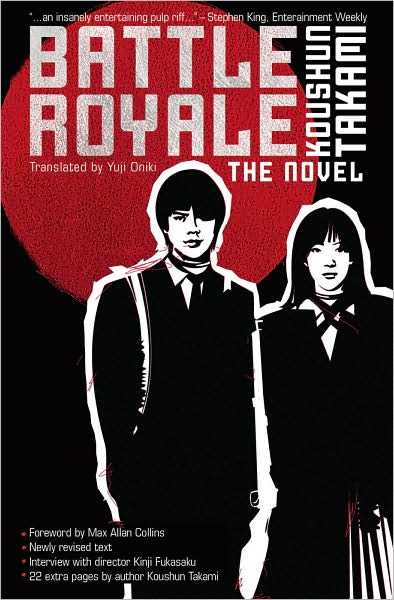
Battle Royale by Koushun Takami


This is not a book for precocious kids who read up. It's not really a book for kids at all, or at least, I don't think it is intentionally. But I can't imagine that some of the older teens (and adults, too for that matter) who read and loved The Hunger Games would not like this rollicking, bloody, and totally graphic novel of middle school students fighting in a death match. Because who doesn't love a story about kids fighting in a death match? Parents, you say? Bah.
For ages at least 15+, this book may fill the void that
Mockingjay (the last in the Hunger Games trilogy) is leaving in the bloodthirsty pit of YA-reader's souls. Though it's not as cleanly (or expertly) written as Hunger Games (which may be in some part on account of being translated) it's almost as addictive, and for added morbidity, the children in this novel have all known each other for years. What follows is an incredibly violent, bloody and horrible fight to the finish, with the most loving descriptions of brains hanging out of a crushed skull that I am likely to ever read.
And if that's not graphic enough for you, check out the manga version.

Incarceron (and Sapphique) by Catherine Fisher

Already published in the UK (and recipient of the Times Children's Book of the year) Incarceron is an awesome YA novel I'm very excited to hand off to fans of The Hunger Games by Suzanne Collins. Though Incarceron is not as readily accessible as Hunger Games (and therefor less likely to appeal to the precocious readers who read UP for Hunger Games), it does have the same undeniable (and addictive!) sense of forward prepulsion. Like Hunger Games, Incarceron is a page turner, with enough violence to appeal even to the blood thirstiest young readers. However, thematically, Incarceron stands very much apart. Set (half) in an enormous, sentient prison, the characters in Incarceron are very much aware that they are under constant surveilance. Even in the parts which take place outside the prison, the characters bear the same burden. Imagine Foucault wrote a speculative sci-fi fantasy novel. For kids. Kids who took to the sight and surveilance themes of Little Brother by Cory Doctorow may also enjoy this novel, if they are willing to go into an alternate universe. Add these themes into a world of a constantly shifting and unstable reality, along with enough serpentine plot twists to make you dizzy, and you have the world of Incarceron.
I liked this book so much that, despite never using Amazon in the US, I hopped on Amazon UK to order the sequel,
Sapphique, which is not out in the states yet. And it was TOTALLY worth my lapse of moral consumerism! It is a worthy follow-up indeed, and it does exactly what a second book in a trilogy should, which is to expand the world we've already encountered and to complicate the problems and relationships of the characters. Fisher uses varying points of view for maximum tension, even that does occasionally mean switching POV as a way of punctuating exciting moments. I am wary of saying too much about this sequel, since I enjoyed it so much because it was so suprising, and I would hate to ruin that experience for anyone else. Suffice to say, it was a pleasure to read, and I anxiously await the third book, which is due out in May (in the UK).

Friday, January 8, 2010

Sisters of the Sword by Maya Snow

I felt obligated to read Sisters of The Sword because one of my most prolific kid reviewers, Clare, told me it would be my kind of book since "there are girl warriors... and I know you like that." Right you are, Clare. So, just on the principle of never saying no to a book that features butt-kicking females, I read Sisters of the Sword over the Thanksgiving break. And Clare was right. There are some tough, butt-kicking females in it. And though the writing was not my favorite, sometimes drifting into the annoyingly didactic when explaining Japanese customs and vocab words (like sansei, which I felt like did not need to be explained, or italicized) it was still a rollicking fun read with likable protagonists at its core. The antagonists, on the other hand, were so evil, that one could in no way have any empathy with them whatsoever, which I found disappointing. Bad guys are usually my favorites, but these were typical, sexist, elitist, evil and most unsatisfyingly two-dimensional. However, for readers yearning for violence, action and all the samurais they can possibly handle, Sisters of the Sword may be just the ticket.

Tuesday, July 7, 2009

Dark Carnival Books

3086 Claremont Ave, Berkeley, CA, 94706.

Go there, for stacks and stacks of the most eccentric, awesome, obscure, culty, random collection of titles ever. The books are literally falling off the walls, in something that resembles alphabetical order, and it's literally my favorite place to waste hours and money. There are plenty of books that I could write down the titles of and order through my store (and plenty used or UK editions that I could not) but I buy them there. Why? Because it's the only place I know that would stock everything that they stock and so they deserve the sale.

Recently purchased there:

The Wizard in the Tree by Lloyd Alexander,

and 3 Bellairs middle-grade horror/mysteries, including one recommended on the Dark Carnival website, The Chessmen of Doom.

Thanks for being awesome, Dark Carnival.

http://www.darkcarnival.com/