Thursday, November 19, 2009

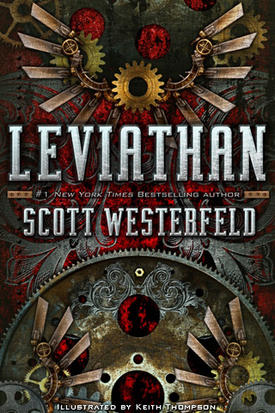
Leviathan by Scott Westerfeld

Adventures in badassery!

Scott Westerfeld, the author of the fun, body-image-centered trilogy,
Uglies, Pretties, Specials, the vampire series, Peeps, and puzzle-horror series, Midnighters, has a new book out, the beginning to a very promising new series. Leviathan, a steam-punk retelling of WWI, is a rollicking start to what I'm hoping is going to be Westerfeld's best series yet! Perspective switches every two chapters between an unseated prince (Aleks), who has been humbled by his parents' deaths, and Derryn, a cross-dressing girl in the British Royal Navy. Driving both characters is the need to keep their true identities secret, and when their paths cross, their central tensions blend in compelling and juicy (yes, juicy) ways.

Like all Westerfeld's novels,
Leviathan kicks off the action immediately, and I was hooked from page one. This world of Clankers (large, mechanical war vehicles) and Darwinist Beasties (hybrid war animal-machines) is so much fun that even though I was seriously pissed when I realized that this book was the first in a series (I shake my fist at you, Scott Westerfeld!!! Now I have to wait???) I can't say I'm not excited to spend more time in this world. For those readers that enjoyed Hunger Games, His Dark Materials, or Eon, this book might be a go. Like Hunger Games, this book moves quickly. Like His Dark Materials it occurs in a world that is at once an alternate past and a possible future. And like Eon, it features a strong, cross-dressing lead, succeeding in a man's role.

I am a little embarrassed to admit I didn't actually read this... I listened to it on audio on the drive from Seattle to San Francisco, as read by the (badass) Alan Cummings (who does an AWESOME job, seriously, AMAZING) but I liked it so much I'm going to read a hard copy, too. I suggest you do, too!

Sunday, October 18, 2009

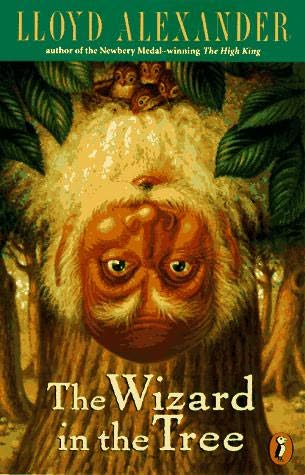
The Wizard in the Tree by Lloyd Alexander

If you're a kid (or adult) who hasn't read Lloyd Alexander's Prydain Chronicles (Newbery Honor for the second book, The Black Cauldron and Newbery Winning for the High King , a series starting with The Book of Three) do it. Sure, it's kind of a Lord of the Rings knockoff for kids, but Alexander's ear for poetry in prose is undeniable, and perfectly suited for children's literature. I loved those books as a kids, and as an adult, reread (sort of... I never really read it in the first place, but knew the plot of all three books since my sister told me the stories so many times I might as well have read them) the Westmark Trilogy, a fabulous trilogy about a revolution from the books up.
So when I found this odd title, The Wizard in the Tree, at my favorite used bookstore in the bay area (Dark Carnival, go guys go) I had to read it. And while it was not quite as good as some of Alexander's other, more famous work, it was still an incredibly enjoyable read, perfect for middle grade readers in the middle of the pack, ages 8 to 12. At times funny, others violent (there are some murders), this book creates a wonderful anti-Potter definition of the true nature of magic, with some clever environmentalist themes that make it timely, even if it is the silly story of a little girl who finds a wizard in a tree.
Complete with plucky heroine, curmudgeonly wizard, and eeeevil (yes, so evil he's eeeevil) squire, The Wizard in the Tree is a clever story from a very clever author, whose breadth of work I am just beginning to appreciate.

And seriously, read the Prydain Chronicles, and its awesome companion book of short stories, The Foundling. Awesome.

Thursday, October 8, 2009

The Egypt Game by Zilpha Keatley Snyder

When I finished the 1968 Newbery Honor book, The Egypt Game, I could for no stretch of the imagination see why it hadn't simply won straight out. Until I realized it was an honor book the year that my very very favorite, From the Mixed-Up Files of Mrs. Basil E. Frankweiler, was the winner. Fair enough, Newbery, fair enough. Apparently 1968 was a good year for kids books, because The Egypt Game was a wonderful story about imagination, learning and the joy of play. I'm so sad I didn't read this book as a child. I know my older sister did, because I found her copy at our mom's house (and didn't steal it, it's still there Mikka, I promise). But I know I would have loved it then, for the very same reasons I love it now.
The Egypt Game starts from the perspective of April Hall, a little girl who's just moved to a new neighborhood so that she can live with her grandmother while her mother runs around Hollywood. Despite the fact that April finds the new town far too provincial for her tastes, she soon makes friends with the decidedly less precocious Melanie Ross, and by proxy, Melanie's very serious little brother, Marshall (who never goes anywhere without his safety octopus, aptly named Safety). The three begin playfully reenacting ancient Egyptian rituals, and are soon joined by two boys, Ken and Toby. With five players in the Egypt game, all bringing their own ideas and research to the table, the game becomes more serious, and when strange things start happening, the kids can't help but wonder if they are making it happen. Meanwhile, a child murderer is in the neighborhood, and everyone suspects the Professor, the strange old man whose backyard is the secret location for the Egypt game.
It's a silly thing to focus on, since there are so many wonderful things about this book, but I loved the characterization of Ken Kamata. Ken plays very reluctantly, and is always a little embarrassed and incredibly self-conscious. There's a fabulously funny illustration in the chapter entitled: Ceremony for the Dead, in which all the children are shown in the wild throws of a dramatic funeral. All except Ken, who (despite being in character by beating his chest) is looking straight out of the page at the reader, a slightly embarrassed look on his face, as though even doing this in front of the reader is just more humiliation than he can bear. Maybe I just like Ken, because when I was a kid, I was a bit like him. I wish I had been a kid like Marshall, but so it goes.
I don't think you can even throw a rock without finding a third or fourth grader who's curious about ancient Egypt. So throw a rock, hit a kid and then buy them a copy of this book. The parents will totally drop charges when they see how awesome the book is. Or you'll go to jail with a funny story about bad advice and good kids books.

Monday, October 5, 2009

The Whipping Boy by Sid Fleischman

The Newbery Winner of 1987 (and illustrated by the great Peter Sis) The Whipping Boy was a surprisingly funny read, complete with dancing bear, blundering con men and a bratty prince with an untapped heart. Even kids who are not necessarily interested in historical fiction will find points of interest in this book. The story is told from the perspective of the prince's whipping boy, an orphan named Jemmy. If you, like me, before I read this book, have no idea what a whipping boy is, it's a designated person to suffer punishments on the prince's behalf. Since the prince in this tale is rotten, Jemmy takes many whippings, a fact the prince cares about very little. When they run away together, Prince Brat (as he is also called) begins to learn the errors of his ways, and he and Jemmy strike up an unlikely friendship. At 89 pages long, even more reluctant readers will be unafraid to pick up this absurd little tale of empathy, trust and friendship. Perfect for early readers making the transition to chapter books, with a pleasantly snarky narrative voice.

Monday, September 21, 2009

after long radio silence...

Alas, I am terrible at keeping up with this blog. But, fortunately, I'm better at reading than I am at writing, and so I have plenty of books to write about! For today, I'll start with these 3:

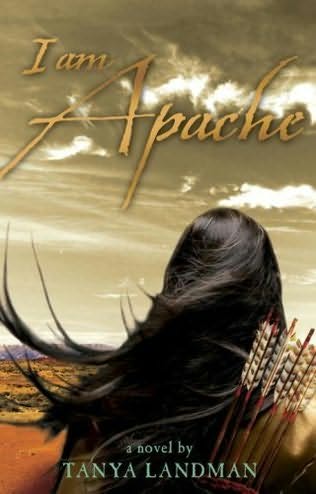
I Am Apache, by Tanya Landman: A YA book meant for readers age 12 and up (but that I have already recommend to mature 10 year old readers), I Am Apache is an elegantly written story about an Apache (duh) woman who decides, after the untimely and violent death of her younger brother, to follow the path to become a warrior. All my ra-ra-ra feminism aside, it's an psychologically compelling read, if not a little heavy-handed. One of the things I've found myself wondering as I read it was (since Landman is British, and hence has not been subjected to all the PA announcement tropes including Native Americans and the environment, you know the one, with the one tear) if some of the language choices were a little stale. A "heart soaring like an eagle over the plain" for example, did not feel particularly fresh. But other than moments like that (of which there were relatively few) it's a wonderful read for those who want to be a tough woman, who are tough women already, or just love tough women on principle.

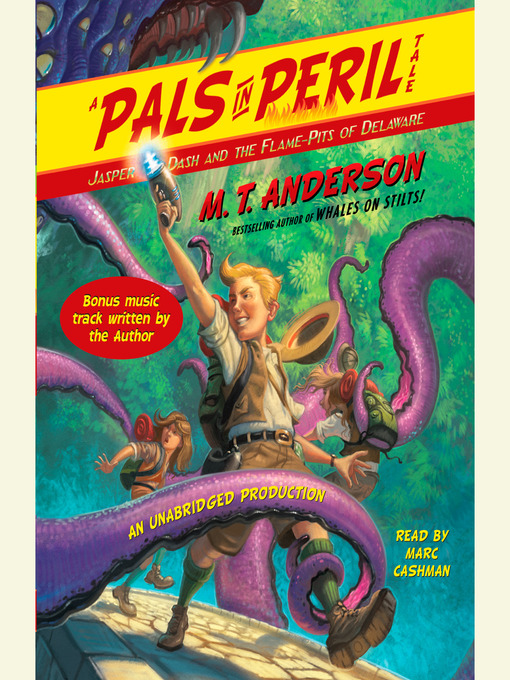
Jasper Dash and the Flame-Pits of Delaware by MT Anderson: Anderson is always my favorite. Even when he's writing silly stories in a fictional Delaware, complete with kangaroo-riding cannibals, he's always the best. In this case for the motherly advice not to fall in love with boys whose names are like boarding schools (Choate, Thatcher, etc) because they'll just break your heart. Sound advice, Mrs. Mulligan. Sound advice. Jasper Dash is the third book in the Pals in Peril Series (previous MT Anderson's Thrilling Tales), a middle grade series in which each book is a satire of a particular genre-- the first was an alien invasion story, the second a mystery. This newest installment is an adventure story, akin to Tarzan, but with way more silliness. It's by far the longest volume in the series, and there are some parts where it gets a little long. But I could see why. I probably wouldn't want to edit anything out either, even if not doing so is to the detriment of the flow. Anderson's fictitious Delaware is so much fun, so absurd, so silly, that I for one couldn't pick anything that had to go.

The Looking Glass Wars by Frank Beddor: My favorite adult-who-reads-kids-books customer recommended this book to me, and I have long since learned that ignoring her recommendations is done at my own peril. So I bought my copy and started reading it. Four months ago. And just now finished it. At first I was really into it-- Wonderland as a more science-fiction like landscape was an exciting prospect. Plus, the cover art and interior illustrations (there's a little section in the middle) are pleasingly stylish. And even the story (Princess Alyss of Wonderland stranded in the real world, Queen Redd wreaking havoc) was fun. In theory. But I never felt myself compelled the keep reading once I'd picked up the book. The narrative voice is scattered since POV changes all the time. I felt like the story might have been better served by a more limited scope of point of view characters, to focus the story a bit more. While Hatter might be the most badass body guard to pop up in kids lit in a while, there's not much psychological depth to him (or many of the other secondary characters). But reading it, I could see that there was a lot this book had to offer, especially for kids who love the dystopian aesthetic. There's action, intrigue, and a tough female lead, and it is a very NEW take on Wonderland. All things I always like. But it still wasn't my favorite.
Tuesday, July 7, 2009

Dark Carnival Books

3086 Claremont Ave, Berkeley, CA, 94706.

Go there, for stacks and stacks of the most eccentric, awesome, obscure, culty, random collection of titles ever. The books are literally falling off the walls, in something that resembles alphabetical order, and it's literally my favorite place to waste hours and money. There are plenty of books that I could write down the titles of and order through my store (and plenty used or UK editions that I could not) but I buy them there. Why? Because it's the only place I know that would stock everything that they stock and so they deserve the sale.

Recently purchased there:

The Wizard in the Tree by Lloyd Alexander,

and 3 Bellairs middle-grade horror/mysteries, including one recommended on the Dark Carnival website, The Chessmen of Doom.

Thanks for being awesome, Dark Carnival.

http://www.darkcarnival.com/

Holes by Louis Sachar

It's amazing that I managed to be thirteen around the time this book came out, and yet was never inclined to read it. I remember hearing about it, or at least being aware of it, but I never even picked it up. In fact, I had some half-baked notion that it was a novel about a summer camp where enormous holes start popping up, magically.
This however, was not the case.
When I picked Holes up to read it as part of my Newbery Challenge deal, I promised my coworker Robyn (hi Robyn!) I would read the book and watch the movie, then compare. Which I did. But I'll start with the book.
Which I loved. There are so many layers to the plot of this intricately woven tale of transgression and atonement, yet it remains incredibly accessible. Debts are repaid. Friends are made. Character is built. Adventures are had. However, all of this is pushed against the violent history shared by black and white people in America, giving the story more resonance than one might have imagined a story that features a kid called "Armpit" might have.
The unlikely hero of this story is Stanley Yelnats, an over-weight, well-meaning pushover with an incredibly sturdy moral compass. When he is sent to Camp Green Lake (for a crime he did not commit), a desert wasteland juvenile detention camp, to dig 5 foot holes on a daily basis as means of penance, he befriends a boy called Zero (short for Hector Zeroni) who is written off by all the other campers and camp authority figures as a failure. He teaches Zero to read, and when Zero runs away from the camp into the foreboding desert, Stanley follows him with intent to rescue.
What made Stanley so likable to me was his lack of cool. He's not a smart-talking, slick guy at heart, even if he manages to come across that way. And that to me, was one of the first things I did not much care for in the movie. Shia Lawhateverhisnameis is just too cool to be Stanley. That next to the fact that the warden (played by Sigourney Weaver) is way more attractive than she is described in the book, the man called Mom is a more bumbling idiot than calculating coward and Zero is far more adorable... well, you get the idea. It seems like in translation the characters became too smooth around the edges for my liking.
So read the book. But don't necessarily see the movie. Unless you like a LOT of meaningful musical interludes, of which there are plenty.