So, it may be fair to point out that while it was not a Newbery medal winner, Nancy
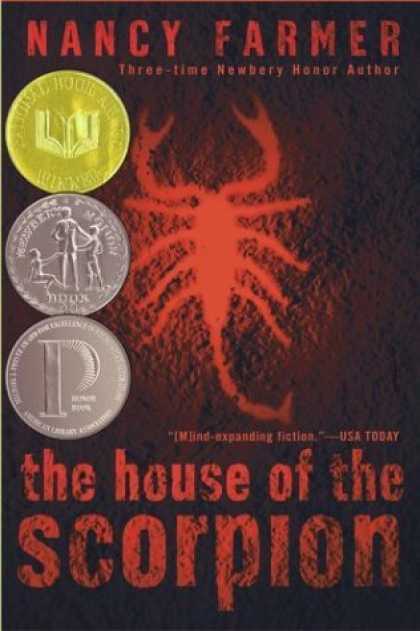 Farmer's House of the Scorpion DID win the National Book Award for Young Adults (and the Printz Honor, as well). The reason for the many accolades this title has accumulated is for a very simple reason: It's awesome. Set in the (not so) distant future, this bleak, dystopian novel takes place on the former border of the US and Mexico, aptly named Opium (for its chief export) from the point of view of a clone. A clone who, he soon realizes, is being raised with the sole purpose of providing organs to the ailing, aging leader of Opium. When harvesting day comes, Matt goes on the run, and the reader gets to tag along on a dark and fascinating tour of the country. What I loved most about this book were the two parental figures that Matt has: Tam Lin the bodyguard, and Celia, the housekeeper. Neither are his biological parents (duh, he's a clone), but they are both such wonderful nurturing parental figures, who give Matt the tools he needs once he goes on the run. I also love that, when I handsell this book, or give it away as a gift, I inevitably hear great reviews laters. My cousin Jack liked it so much he made his parents read it. Who of course, loved it also.
Also by Nancy Farmer, another Newbery Honor book, is A Girl Named Disaster. Set in  contemporary Mozambique and Zimbabwe, this wonderful tale of survival, bravery and redemption was also a really cool field guide to African plants and animals. There's a fabulous passage in which Nhamo, the main character, lives among a troop of baboons. After reading Sapolsky's A Primate's Memoir, I was particularly fond of this passage, because Farmer's depictions of the baboons and their social structure matched up with Sapolsky's non-fiction (neuroscientist's perspective) account. Good for kids (probably mostly girls, but I'd try boys on it anyway) ages 10 and up, this novel also serves as a really great introduction to the nature of daily life in different places in Africa. Though Nhamo comes from a tribal village, she travels in solitude in the wilderness, and then ends up in a large city. The cast of characters include her fellow tribesmen, missionaries, Portuguese traders, jaguars, baboons, ghosts, scientists... the list goes on. Vividly decsribed, and thoroughly rendered, A Girl Named Disaster is a great book for kids who like learning about other cultures, or survival/adventure stories.
 Farmer's third (THIRD) Newbery Honor book, The Ear, the Eye and the Arm, is also set in Zimbabwe. Only this time, it's a century into the future. A bit like a riff on The Wizard of Oz, complete with witch, but minus Toto, The Ear, the Eye and the Arm stars three runaway children, and the three detectives (for whom the book is named, each given a name coupled with their deformities) who are sent to find them. The cast of characters and variety of locations in this novel are head-bogglingly vast (in a good way) and thoroughly imagined. I was impressed with Farmer's ability to weave in true details about tribal culture in Zimbabwe in this otherwise fantastical novel. I'm bummed, however, that the current cover is a little strange looking, and that a lot of kids seem to see that bright blue monkey on the front, and decide preemptively that they're just not interested. Which is a shame, because it's a rollicking adventure of a book, one I imagine would be well suited for full-family read alouds, since it has enough substance to entertain the older kids, and is not too (just a little) terrifying for the younger ones.
 contemporary Mozambique and Zimbabwe, this wonderful tale of survival, bravery and redemption was also a really cool field guide to African plants and animals. There's a fabulous passage in which Nhamo, the main character, lives among a troop of baboons. After reading Sapolsky's A Primate's Memoir, I was particularly fond of this passage, because Farmer's depictions of the baboons and their social structure matched up with Sapolsky's non-fiction (neuroscientist's perspective) account. Good for kids (probably mostly girls, but I'd try boys on it anyway) ages 10 and up, this novel also serves as a really great introduction to the nature of daily life in different places in Africa. Though Nhamo comes from a tribal village, she travels in solitude in the wilderness, and then ends up in a large city. The cast of characters include her fellow tribesmen, missionaries, Portuguese traders, jaguars, baboons, ghosts, scientists... the list goes on. Vividly decsribed, and thoroughly rendered, A Girl Named Disaster is a great book for kids who like learning about other cultures, or survival/adventure stories.
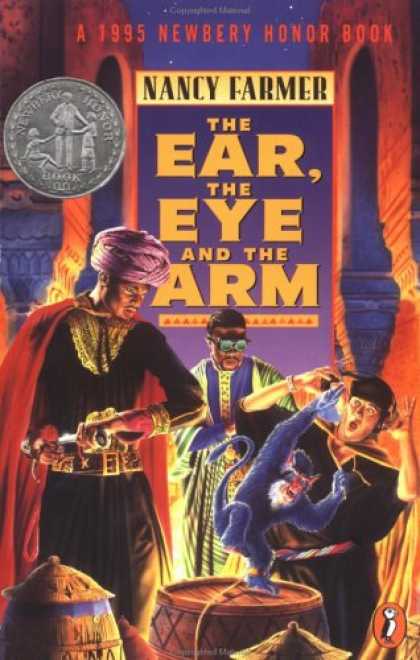 Farmer's third (THIRD) Newbery Honor book, The Ear, the Eye and the Arm, is also set in Zimbabwe. Only this time, it's a century into the future. A bit like a riff on The Wizard of Oz, complete with witch, but minus Toto, The Ear, the Eye and the Arm stars three runaway children, and the three detectives (for whom the book is named, each given a name coupled with their deformities) who are sent to find them. The cast of characters and variety of locations in this novel are head-bogglingly vast (in a good way) and thoroughly imagined. I was impressed with Farmer's ability to weave in true details about tribal culture in Zimbabwe in this otherwise fantastical novel. I'm bummed, however, that the current cover is a little strange looking, and that a lot of kids seem to see that bright blue monkey on the front, and decide preemptively that they're just not interested. Which is a shame, because it's a rollicking adventure of a book, one I imagine would be well suited for full-family read alouds, since it has enough substance to entertain the older kids, and is not too (just a little) terrifying for the younger ones.
And now, for something completely different.
From Zilpha Keatley Snyder, author of the fantabulous-oh-my-gosh-it's-so-good (Newbery Honor) The Egypt Game, is The Headless Cupid, another Newbery Honor book, with just a light touch of creepy. Like the Egypt Game, the kids in The Headless Cupid are trying to create rituals (though, this time of the occult, not from Ancient Egyptian custom) with what could be some effect. Also like the Egypt Game, this novel features a wide cast of characters, including one very precocious young lady, and a very earnest and responsible older brother. The kids, whose parents have just been married, have all moved into a large, country house together, that has a history of its own. Amanda, an only child now subjceted to four new siblings, is convinced (and convinces the others) that she can make contact with the ghost who lives there. Part mystery, part ghost story, The Headless Cupid also offers up a wonderful story about becoming a new kind of family. I truly cherished how lovingly and accurately family life is depicted, and would recommend this to all the kids who liked The Egypt Game (of course), but also to those who liked Steinbeck's Ghost, by Lewis Buzbee.
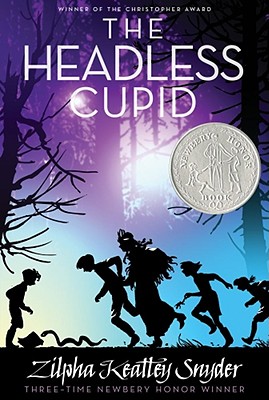 Honor) The Egypt Game, is The Headless Cupid, another Newbery Honor book, with just a light touch of creepy. Like the Egypt Game, the kids in The Headless Cupid are trying to create rituals (though, this time of the occult, not from Ancient Egyptian custom) with what could be some effect. Also like the Egypt Game, this novel features a wide cast of characters, including one very precocious young lady, and a very earnest and responsible older brother. The kids, whose parents have just been married, have all moved into a large, country house together, that has a history of its own. Amanda, an only child now subjceted to four new siblings, is convinced (and convinces the others) that she can make contact with the ghost who lives there. Part mystery, part ghost story, The Headless Cupid also offers up a wonderful story about becoming a new kind of family. I truly cherished how lovingly and accurately family life is depicted, and would recommend this to all the kids who liked The Egypt Game (of course), but also to those who liked Steinbeck's Ghost, by Lewis Buzbee.
Lastly, the National Book Award Finalist, The Tiger Rising, by  Kate DiCamillo. DiCamillo won the Newbery for her novel, The Tale of Despereaux, in 2003. I also have high hopes for her novel that came out this year, The Magician's Elephant, for the 2009 Newbery. But Tiger Rising was something altogether different than the other DiCamillo books that I have read. The narrator has such a soft touch in this tale of redemption, sadness and loss, and as such it rings a completely different chord than her other books that I have read, all of which utilize a very voicey narrator who takes you, safely, to that happy storytime place. There is no such distance from the content in Tiger Rising, and I think rightfully so. The main character, Rob, is dealing with the loss of his mother-- there's no making that any softer. As he grapples with serious emotional repression, he finds a tiger, in a cage, in the forest. Simply wrought with majorly resonant results, The Tiger Rising is a tale of unlikely friendship, and the feelings of which we're most afraid. And I cried, and I cried, and I cried. On the BART train. Great for ages 7 or 8 and up.
 Kate DiCamillo. DiCamillo won the Newbery for her novel, The Tale of Despereaux, in 2003. I also have high hopes for her novel that came out this year, The Magician's Elephant, for the 2009 Newbery. But Tiger Rising was something altogether different than the other DiCamillo books that I have read. The narrator has such a soft touch in this tale of redemption, sadness and loss, and as such it rings a completely different chord than her other books that I have read, all of which utilize a very voicey narrator who takes you, safely, to that happy storytime place. There is no such distance from the content in Tiger Rising, and I think rightfully so. The main character, Rob, is dealing with the loss of his mother-- there's no making that any softer. As he grapples with serious emotional repression, he finds a tiger, in a cage, in the forest. Simply wrought with majorly resonant results, The Tiger Rising is a tale of unlikely friendship, and the feelings of which we're most afraid. And I cried, and I cried, and I cried. On the BART train. Great for ages 7 or 8 and up.

 in less than two hundred pages, he doesn't just address the writer's side, but also the process in which stories are created and the many mechanisms within stories that make them move forward. Hence the very apt comparison to clocks, which are, throughout the entire story, a relentless motif. That was my reading of it.