I liked this book so much that, despite never using Amazon in the US, I hopped on Amazon UK to order the sequel, Sapphique, which is not out in the states yet. And it was TOTALLY worth my lapse of moral consumerism! It is a worthy follow-up indeed, and it does exactly what a second book in a trilogy should, which is to expand the world we've already encountered and to complicate the problems and relationships of the characters. Fisher uses varying points of view for maximum tension, even that does occasionally mean switching POV as a way of punctuating exciting moments. I am wary of saying too much about this sequel, since I enjoyed it so much because it was so suprising, and I would hate to ruin that experience for anyone else. Suffice to say, it was a pleasure to read, and I anxiously await the third book, which is due out in May (in the UK).
Wednesday, March 3, 2010
Incarceron (and Sapphique) by Catherine Fisher
Already published in the UK (and recipient of the Times Children's Book of the year) Incarceron is an awesome YA novel I'm very excited to hand off to fans of The Hunger Games by Suzanne Collins. Though Incarceron is not as readily accessible as Hunger Games
(and therefor less likely to appeal to the precocious readers who read UP for Hunger Games), it does have the same undeniable (and addictive!) sense of forward prepulsion. Like Hunger Games, Incarceron is a page turner, with enough violence to appeal even to the blood thirstiest young readers. However, thematically, Incarceron stands very much apart. Set (half) in an enormous, sentient prison, the characters in Incarceron are very much aware that they are under constant surveilance. Even in the parts which take place outside the prison, the characters bear the same burden. Imagine Foucault wrote a speculative sci-fi fantasy novel. For kids. Kids who took to the sight and surveilance themes of Little Brother by Cory Doctorow may also enjoy this novel, if they are willing to go into an alternate universe. Add these themes into a world of a constantly shifting and unstable reality, along with enough serpentine plot twists to make you dizzy, and you have the world of Incarceron.
I liked this book so much that, despite never using Amazon in the US, I hopped on Amazon UK to order the sequel, Sapphique, which is not out in the states yet. And it was TOTALLY worth my lapse of moral consumerism! It is a worthy follow-up indeed, and it does exactly what a second book in a trilogy should, which is to expand the world we've already encountered and to complicate the problems and relationships of the characters. Fisher uses varying points of view for maximum tension, even that does occasionally mean switching POV as a way of punctuating exciting moments. I am wary of saying too much about this sequel, since I enjoyed it so much because it was so suprising, and I would hate to ruin that experience for anyone else. Suffice to say, it was a pleasure to read, and I anxiously await the third book, which is due out in May (in the UK).
Friday, January 8, 2010
Sisters of the Sword by Maya Snow
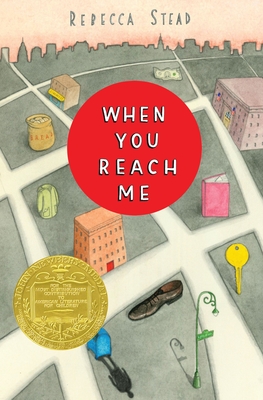
When You Reach Me by Rebecca Stead
Mrs. Frisby and the Rats of Nimh by Robert C. Obrien
Winner of the 1972 Newbery Medal, Mrs Frisby and the Rats of Nimh, from the author of Z for Zachariah and The Silver Crown, is a thoroughly imagined tale of
mice, medication, and one of the toughest moms in all of kids' lit. Mrs. Frisby is a widow, with four small children, one of whom is gravely ill. In order to keep her son Timothy alive, she must contract the help of the rats of NIMH, former lab rats who, after being subjected to steroids, tests, captivity and other such calamities, escape into the countryside. It is not long before it is revealed that Mr. Frisby was the only suriviving mouse for said experiments. Mrs. Frisby, who is not gifted as the rats are or her husband was, braves owls, cats and rat poison in the name of familial love. What I found most striking about this book was the complexity of the rats' world. Though talking rats and mice and crows and shrews do not exist, the world they inhabit in this novel comes across as completely reasonable, and the tests the rats describe have a surprisingly element of realism. Perfectly suited for reading aloud with the whole family, (with a few slyly funny moments, to boot) this book was a pleasure to reread. It was also made into an awesome movie in 1982, entitled The Secret of Nimh.
Wednesday, December 30, 2009
What do you MEAN they didn't win?
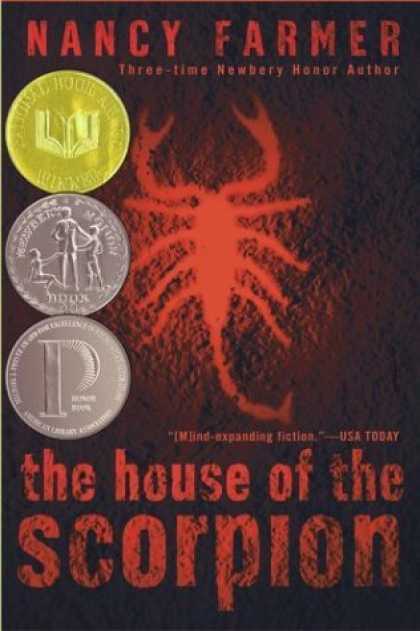
I should just rename this post: Zilpha Keatley Snyder and Nancy Farmer just can't win... but that would sound mean. Even if it is true. Both authors, whose books are generally beloved, and who exercise no small amount of talent, have been Newbery runner-ups three times each. Three times! I don't think I've ever gotten second place for anything of note ONCE. I'm sure they have far more mature reactions to this phenomenon, but I'll be indignant on their behalves. Newbery, why do you torture them so?
So, it may be fair to point out that while it was not a Newbery medal winner, Nancy
Farmer's House of the Scorpion DID win the National Book Award for Young Adults (and the Printz Honor, as well). The reason for the many accolades this title has accumulated is for a very simple reason: It's awesome. Set in the (not so) distant future, this bleak, dystopian novel takes place on the former border of the US and Mexico, aptly named Opium (for its chief export) from the point of view of a clone. A clone who, he soon realizes, is being raised with the sole purpose of providing organs to the ailing, aging leader of Opium. When harvesting day comes, Matt goes on the run, and the reader gets to tag along on a dark and fascinating tour of the country. What I loved most about this book were the two parental figures that Matt has: Tam Lin the bodyguard, and Celia, the housekeeper. Neither are his biological parents (duh, he's a clone), but they are both such wonderful nurturing parental figures, who give Matt the tools he needs once he goes on the run. I also love that, when I handsell this book, or give it away as a gift, I inevitably hear great reviews laters. My cousin Jack liked it so much he made his parents read it. Who of course, loved it also.
So, it may be fair to point out that while it was not a Newbery medal winner, Nancy
Also by Nancy Farmer, another Newbery Honor book, is A Girl Named Disaster. Set in
contemporary Mozambique and Zimbabwe, this wonderful tale of survival, bravery and redemption was also a really cool field guide to African plants and animals. There's a fabulous passage in which Nhamo, the main character, lives among a troop of baboons. After reading Sapolsky's A Primate's Memoir, I was particularly fond of this passage, because Farmer's depictions of the baboons and their social structure matched up with Sapolsky's non-fiction (neuroscientist's perspective) account. Good for kids (probably mostly girls, but I'd try boys on it anyway) ages 10 and up, this novel also serves as a really great introduction to the nature of daily life in different places in Africa. Though Nhamo comes from a tribal village, she travels in solitude in the wilderness, and then ends up in a large city. The cast of characters include her fellow tribesmen, missionaries, Portuguese traders, jaguars, baboons, ghosts, scientists... the list goes on. Vividly decsribed, and thoroughly rendered, A Girl Named Disaster is a great book for kids who like learning about other cultures, or survival/adventure stories.
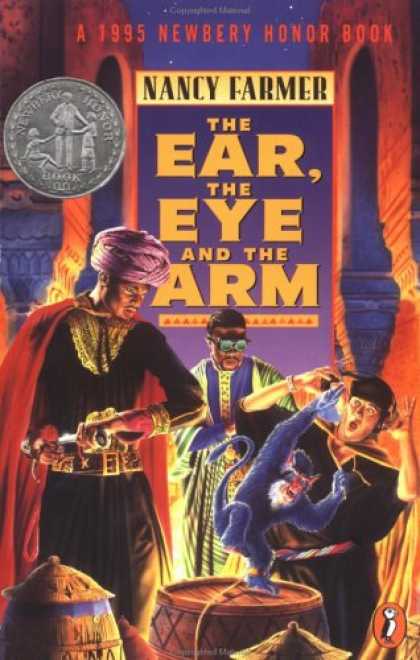
Farmer's third (THIRD) Newbery Honor book, The Ear, the Eye and the Arm, is also set in Zimbabwe. Only this time, it's a century into the future. A bit like a riff on The Wizard of Oz, complete with witch, but minus Toto, The Ear, the Eye and the Arm stars three runaway children, and the three detectives (for whom the book is named, each given a name coupled with their deformities) who are sent to find them. The cast of characters and variety of locations in this novel are head-bogglingly vast (in a good way) and thoroughly imagined. I was impressed with Farmer's ability to weave in true details about tribal culture in Zimbabwe in this otherwise fantastical novel. I'm bummed, however, that the current cover is a little strange looking, and that a lot of kids seem to see that bright blue monkey on the front, and decide preemptively that they're just not interested. Which is a shame, because it's a rollicking adventure of a book, one I imagine would be well suited for full-family read alouds, since it has enough substance to entertain the older kids, and is not too (just a little) terrifying for the younger ones.
And now, for something completely different.
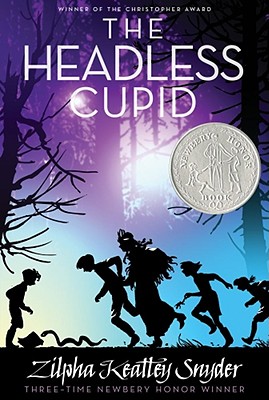
From Zilpha Keatley Snyder, author of the fantabulous-oh-my-gosh-it's-so-good (Newbery
Honor) The Egypt Game, is The Headless Cupid, another Newbery Honor book, with just a light touch of creepy. Like the Egypt Game, the kids in The Headless Cupid are trying to create rituals (though, this time of the occult, not from Ancient Egyptian custom) with what could be some effect. Also like the Egypt Game, this novel features a wide cast of characters, including one very precocious young lady, and a very earnest and responsible older brother. The kids, whose parents have just been married, have all moved into a large, country house together, that has a history of its own. Amanda, an only child now subjceted to four new siblings, is convinced (and convinces the others) that she can make contact with the ghost who lives there. Part mystery, part ghost story, The Headless Cupid also offers up a wonderful story about becoming a new kind of family. I truly cherished how lovingly and accurately family life is depicted, and would recommend this to all the kids who liked The Egypt Game (of course), but also to those who liked Steinbeck's Ghost, by Lewis Buzbee.
Lastly, the National Book Award Finalist, The Tiger Rising, by
Kate DiCamillo. DiCamillo won the Newbery for her novel, The Tale of Despereaux, in 2003. I also have high hopes for her novel that came out this year, The Magician's Elephant, for the 2009 Newbery. But Tiger Rising was something altogether different than the other DiCamillo books that I have read. The narrator has such a soft touch in this tale of redemption, sadness and loss, and as such it rings a completely different chord than her other books that I have read, all of which utilize a very voicey narrator who takes you, safely, to that happy storytime place. There is no such distance from the content in Tiger Rising, and I think rightfully so. The main character, Rob, is dealing with the loss of his mother-- there's no making that any softer. As he grapples with serious emotional repression, he finds a tiger, in a cage, in the forest. Simply wrought with majorly resonant results, The Tiger Rising is a tale of unlikely friendship, and the feelings of which we're most afraid. And I cried, and I cried, and I cried. On the BART train. Great for ages 7 or 8 and up.
Tuesday, November 24, 2009
Clockwork by Philip Pullman
Pullman, author of the amazing Dark Materials Trilogy, (which I plan to reread around Christmas, it's an awesome cold-weather read) is expert at taking large, complex ideas and making them accessible for kids. In this case, rather than a making a deftly crafted treatise against organized religion, Pullman turns his eye on storytelling. And,
in less than two hundred pages, he doesn't just address the writer's side, but also the process in which stories are created and the many mechanisms within stories that make them move forward. Hence the very apt comparison to clocks, which are, throughout the entire story, a relentless motif. That was my reading of it.
But what really makes this book awesome is that it's a good, straight ahead story, too. It boasts a rich cast of characters, including a brave young heroine, an overwhelmed clockmaker, a writer and a man who may or may not be the devil himself. It does have a few scary moments (murders can be rough for the more sensitive readers and this one is pretty visceral), and so generally I would recommend it for ages eight and up to avoid nightmares with the younger, precocious readers who read above their level. It's not as creepy as Coraline, by Neil Gaiman (which I also totally recommend, a succinct, fun but totally creeperiffic) which I have received more than one angry customer complaint about on the grounds that it is too, too scary. But it IS scarier than, say, a Roald Dahl book, even if that headmistress CAN chuck you into the great, blue yonder.
Thursday, November 19, 2009
A Wrinkle In Time by Madeleine D'Engle
Sometimes, I can't remember if I actually read a book as a child, or if my older sister, Mikka, did, and just told me the entire plot so comprehensively that I think that I did. Like Lloyd Alexander's Westmark Trilogy, (an awesome series about a revolution that goes from the
books up) the Newbery Winner, A Wrinkle in Time, was a book I knew the story of, but had never actually read. I realized this when I reread it last month, and came across passages I knew I had never heard before-- passages of startling imaginative resonance, and surprising (but realistic) romance. I can see, easily, why this book won the Newbery.
L'Engle said, in her Newbery acceptance speech, that the best books are the ones that provide just a little bit of light against the overwhelming darkness of our world. And A Wrinkle in Time is a book that does just that. According to Lewis Buzbee (author of the fabulous Steinbeck's Ghost, which, incidentally, begins with a reference to Comazotz, the scary-zombie-like planet) more people site A Wrinkle in Time as their favorite childhood book, than any other title. While I can't agree (because I never read it as a child) I can see how this would be true. The possibilities for a child's impact on the world, as imagined in this story, are vast, yet still dependent on innate traits any child might have. Walking the line between fantasy and science-fiction, with the emotional rawness of realism, A Wrinkle in Time was a pleasure to finally read.
Subscribe to:
Posts (Atom)