Friday, August 20, 2010

ATTACK of the Fluffy Bunnies by Andrea Beaty

When twins Kevin and Joules Rockman are sent to summer camp, they find their summer filled with something even more awful than sing alongs: large, fuzzy white bunny aliens who eat people and then hijack their bodies for their own malevolent purposes. Playfully illustrated by Dan Santat, Attack of the Fluffy Bunnies delivers everything that the title promises. Short chapters and a diabolically goofy conceit make this story the perfect read for that snarky kid who doesn't care less about the Hardy Boys. So if you know a 7-10 year old who loved Whales on Stilts, Zombiekins or the oldie-but-hopefully-still-goodie, My Teacher is an Alien, then this is the book for them.
I was really surprised when I found this silly, rollicking tale of fuzzy alien invasion, since author Andrea Beaty's previous book, Cicada Summer, is a serious story about trauma, healing and forgiveness. But, like M.T. Anderson, Beaty has proven herself adept in at least two different voices. And though Attack of the Fluffy Bunnies is unlikely to make any curriculum, it's a great book for reluctant readers with an eye for the extremely silly.

Friday, August 13, 2010

Scott Pilgrim, the books, the movie, the epic of epic epicness


Scott Pilgrim Versus the World hits the theaters today, but I'm happy to say that I've already seen it twice. Yes, I'm that super-dork who talked her way into two screenings (thanks Roommate!) one of which was at Pixar (yessss, nerdgasm) and who, despite having seen this movie twice in the last two weeks, still wants to go see it in theaters to support it in the box office. And I hope you do, too.
Based on the series of 6 graphic novels by Brian Lee O'Malley (yay for creative hapas!), Scott Pilgrim the movie (named for the second book of the series) is fabulously adapted by super slick director Edgar Wright, who also directed a few of my other favorite movies, Shawn of the Dead and Hot Fuzz (starring the awesome and hilarious Simon Pegg). While I had a little bit of a hard time getting into the graphic novel series because of the aesthetic (giant manga eyes, particularly, and characters who look very much the same other than their hair-dos) I did like it even though I stopped at the 4th book. But the movie was better for its brevity-- crazy kinetic and stuffed full of great one-liners, sight gags and hilarious/awesome fight sequences and the coolest arcade game visual style ever made the movie go so fast that I worried I might have missed things since I was laughing so hard. I was particularly keen on Thomas Jane's cameo as the vegan police. Leading boy/man Micheal Cera does an awesome job bringing humor and vulnerability to Scott's character, and Kieran Culkin kills it as Scott's gay roommate, Wallace. I'd list everyone who was awesome, but there's no weak link in the chain-- the acting is great, the humor is campy and the arc is deceptively sentimental.
Read the books to get into the world. Watch the movie to revel in it.

Monday, August 9, 2010

New Story Time Picks


For the Toddlers: A Sick Day for Amos McGee (by Philip and Erin Stead) is a very sweet and very simply story about a zookeeper's life on a normal day, and then his life when he has to stay home sick. The repetitive structure and adorable animals help keep the younger set seated and listening, and the woodblock/pencil illustrations and limited palatte create a low impact, soft setting that suits younger readers nicely. I've read this story a couple times at story time, and while it does not quite engage the 4+ set, those who are younger give all the telltale signs of enjoyment, which really just means that they listen the whole way through.

For the 3-6yr olds: A Pirate's Guide to First Grade (by James Preller and Greg Ruth) went over swimmingly at this weekends' totally boy dominated storytime. We had three incoming first graders in the crowd who were especially pleased. Those who were not quite ready for first grade were equally amused, or at least were amused by my awful pirate voice (yarrr). What cracked me up as I read this story was that the kids were laughing the whole time, even when they had no idea what the pirate jargin meant. While I like to think that they may remember that "choppers" means teeth now, I have the sneaky suspicion that the idea of talking like a pirate at school was enough to keep the giggles coming for all 39 pages. I'm just glad I don't have to keep reading How I Became a Pirate (Melinda Long and David Shannon) over and over again in order to sate the still staggering need for pirate-voice stories. Yar.For Mixed Ages: Dog Loves Books (by Louise Yates) is a book guaranteed to have bookseller support since Dog, as the title promises, loves books so much that he opens his own bookstore. And while it's a store with little to no foot traffic, Dog passes the time reading books, and going places he'd never imagined with things like dinosaurs and martians and monsters. The kids at storytime were perhaps a little less amused by the bookseller jokes as I was, but they did love the pink pterodactyl, the kangaroos, the planes, the swords and all the adventures Dog finds in his books. As my coworker Bob put it on his shelf-talker: "Dog Loves Books: A gritty and unflinchingly realistic portrayal of the challenging and hurly-burly world of bookselling." Just what Yates was going for, I'm sure.

Monday, July 26, 2010

The Goats by Brock Cole

In the opening chapter of The Goats, two outcasts, a boy and a girl, are stripped and left on an island in a cruel summer camp tradition. Though the idea is that they will jump on the opportunity and make like wild island goats, the boy and the girl instead embark on a journey in which they find each other, themselves and love before sex.

Cole pulls no punches in this startlingly sexual (yet complete devoid of actual sexual activity) story. The opening chapter reads like a rape scene. The boy and the girl, humiliated and terrified, spend the opening three chapters naked in each other's company. The boy, who the reader gathers has not quite hit puberty yet, notes that the girl has pubic hair where he does not, but no more is made of it. Cole's hand is purposeful and spare, but not overbearing. The kids maneuver their way off the island and into the world, journeying from a place of strict social hierarchy and embarrassment to a place in which they at least know they have one another.

I loved this book. The story of sexual awakening is practically ubiquitous in YA, a genre defined by coming of age stories, yet I've never read one this honest, this head on. I was shocked to find that this book was originally published in 1989, and had simply come back to our store as a new edition, though I guess I shouldn't be-- sex is sex and growing up is growing up no matter when it's written. Still, the novel holds up, and it doesn't cease to be startling, which is much more interesting to me than the shock value of a limousine deflowering scene (Gossip Girl) or a vamp's ice cold hands up the prom queen's skirt. I finished this book nearly a month ago, and haven't stopped thinking about it since. The central relationship is
that complicated, the social structure is that intricately wrought, the emotional landscape is that evocative.

If I got to chose one book that I've read this year to MAKE kids 12-15 read, this would be it. Elegantly crafted, dangerously insightful, I hope this new (and much improved) cover of
The Goats gets all the attention it deserves.

Tuesday, June 29, 2010

Forthcoming Titles: ARC Reviews

One of the best parts about being a bookseller is getting to sift through all the ARCs that we get shipped to the store from various publishers. I've never grown out of the stage in my life in which free=awesome, and so the novelty of ARCs has not worn thin for me yet. Reviewed below are three ARCs I've read in the last couple of months that I got a kick out of:

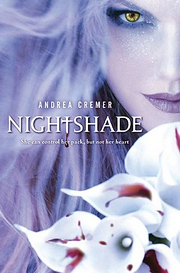
My threshhold for paranormal romance is very, very low, but I was invited to a dinner with Andrea Cremer, the author of Nightshade, by the awesome Penguin sales rep so I read it despite the subtitle: She can control her pack but not her heart, which gave me serious pause (as did the cover, which has more sparkles than I can reasonably tolerate). And even though I didn't end up making it to the dinner it was worth the read. Cremer utilizes the now familiar trope of one girl/two-different-but-both-attractive guys to nice, tense effect, and despite the fact that I am not interested in the subject matter, and did not even particularly care for the sentence level writing style, I was still sucked into the story, in which romance and twists are plenty. The protagonist, Calla, is an alpha female set to mate with the alpha of a rival pack (Ren) in order to create an alliance, and her strength and comfort with her own power made her an appealing lead. But, of course, there's a new boy at school, who's smart (as his pedantic in and out of class eruptions are meant to illustrate) kind and handsome, and Calla finds herself struggling to give herself over to Ren, the cocky, lady-killer, babe-wolf with whom she's been matched. Lust, suspense and monsters aplenty ensue, Calla makes her choice, and a sequel looms on the horizon. A fun, light read with the page-turning propulsion of romance, I would totally recommend this book to lovers of Twilight, Shiver and other vamp/wolf/angel/fairy/zombie/ghost/whatever romances.

Also from Penguin (Dutton, specifically) is Matched, a new romance/dystopia from Ally Condie, which I picked up due to the promise that: "This is a perfect dystopian novel, sure to be a hit with fans of The Giver and The Hunger Games" from Colleen Conway, field sales. While I in no way agree that this book has the same appeal of The Hunger Games, I do see Colleen's point about the Giver; and indeed, Matched reads something like The Giver, if The Giver was wrought with all the teenaged romantic angst that I could handle. Like Nightshade, Condie utilizes the one girl/two guys trope, and again, to pleasantly tense effect. Set in the future, people in Matched are, just as the title promises, matched with the person they will marry by a system of people and computers, and the protagonist in Matched is pleased to find that she has been matched with her handsome best friend. But, just like Nightshade, another boy pops up in her life, and she has trouble giving herself over to the boy with whom she's been matched. However familiar the story, the writing style of this book is lovely, with elegant descriptions and passages of dialog that kept me tuned in, even as the critic in me whined about the overuse of the love triangle in YA. The future Condie imagined is one of cold plastic, tightly controlled art (only 100 poems, 100 songs, 100 paintings remain) and lives that was compelling, and, I imagine, particularly resonant for teens who may feel as though too much of their lives are controlled by outside forces. Come November, I will be pleased to recommend this book as a gift who kids who love dystopian novels.

Lastly was the new graphic novel from Scholastic, Ghostopolis by Doug TenNapel. Set in a fuzzily defined Underworld, Ghostopolis is the story of fatally sick boy Garth, and Frank Gallows, the ghost hunter who accidentally sends Garth to the land of the dead. As Garth goes on an adventure, learning his full potential and getting to know the soul of his prodigal grandfather, Frank and his ghostly ex girlfriend Claire Voyant go on the search to bring Garth home to his poor, terrified mother. Though the story and the setting often make little to no sense, I kept reading because the humor and the drawing style were to appealing that I couldn't make myself put it down. I was particularly fond of Frank's face, which ranges in emotion from weary to irreverent, to deeply in love. The limited palatte of colors suits the Underworld nicely, and utilizes more warm hues than one might have imagined would work for the land of the dead. I'm not exactly sure who I should recommend this book to, other than aspiring illustrators, but I'm pleased to see it on our shelf just the same.

Tuesday, May 25, 2010

The Geek Shall Inherit the Earth: For the Win by Cory Doctorow

I loved Cory Doctorow's Little Brother. I loved that it was entertaining, compelling and that it taught me about a wide variety of geeky tech things I didn't know a damn thing about. I loved its honesty about scary things like government, sex and violence. I loved its moral compass. I loved its idealism. I loved the way it textured my life after I read it, how I couldn't help but think of the things I'd learned when I made a withdrawal from the bank, used Fastrak, bought Mac products.
But I loved
For the Win even more.
When I was in high school and was forced in my senior year to take economics, I HATED IT. It was a close second to my least favorite subject of math (at the time statistics) which makes sense. Both disciplines require attention to detail, number crunching, formulas. Things I do not like. And my continuing near complete ignorance in regard to all things money related has come back to bite me in the butt on numerous occasions, not least of all raising its head during the entire economic meltdown, which, when asked about it I would have to say things like: "It's just bad news all around," and/or "Um yes, I guess the president
should fix this... how? Oh wow, look over there!" [runs away]
So, despite what several reviewers cited as didactic passages, I loved how much I was able to learn from this book. Yes, I understand that this book is meant for teens. Yes, I know I should have known a lot of this stuff going into this book. Yes, I get that for people who already know all this, the "here's what's happening when people sell you stock" passages may feel overly didactic. But for someone totally ignorant (me!) it was great-- Doctorow makes all this stuff that made me want to stick glass in my eyes during high school totally interesting, fascinating even, and most of all cool. His comparisons are fresh, humorous and intelligent. The passage about the Coase cost utilizes light touches of neuroscience to help people like me engage, and feel clever for being able to do so.
If there's anything I cared about less than econ, it's online gaming. I'm a total nerd for some things (...I keep a blog of kids' book reviews...in my adult life) but online RPGs are just past my threshold. And by just past, I mean way past. And just like econ, Doctorow was able to pull me in, despite overwhelming prejudice. I still don't want to play the games, but I have a new found interest in the people who do, and the meta-markets they support.
Set in 4 different countries, with an epic cast of characters, Doctorow puts a face to globalization in a way that is undeniably
cool, without glorifying the characters--there's a great moment of self-awareness when one of the 2 main American characters, a white kid named Leonard who goes by Wei-Dong (in order to fit in with his remote Chinese gamer friends) is forced to remind himself why he's gotten involved with the burgeoning online-revolution, and the loneliness inherent in his lifestyle. Each major character has a moment when they question fighting for a cause with people in countries they will never go to, and comrades they will never meet, to fantastic effect: the "real world" becomes an outmoded term, and the world of the gamers asserts itself.
These elements in conjunction with Doctorow's strong use of interpersonal relationships pressed against these larger frameworks, I felt, alleviates the (arguable) slowness of the didactic passages, keeping the plot tense and (most of) the dialog taut. If I had one complaint, it would be that the passages in which concepts are explained between Ashok the economist and General Robotwallah (Mala) and Yasmin in India feel a bit lazy, whereas the passages in which Connor (a game runner and student of economics) explains things to the reader do not. It makes sense that Connor's POV would include these passages. The conversations in India, on the other hand, feel expository, and are less fun in the telling. However, all conversations between Lu (a gamer) and Jie (his covert-revolutionary-radio host girlfriend) are so real, Lu's tenderness and vulnerability and Jie's self-defensive strength so compelling, that I could imagine an entire novel just about the two of them being written.
Just like in
Little Brother, Doctorow takes an incredibly idealistic concept, and backs it up with intelligence and logic, providing a strong, contrarian moral compass similar to that used by MT Anderson. It's probably obvious that I loved this book, and I admit that I'm predisposed to agreeing with both Doctorow and Anderson's senses of morality. But whether or not one agrees with the politics presented in this novel, I think there is enough meat and scope to at least be of interest to even the most labor-union-hating, gamer-despising, fiscally conservative reader, because ultimately, it's just a great story. And anyone can like a good story.

Wednesday, May 19, 2010

Kids Classic I Forgot to Read: My Father's Dragon by Ruth Stiles Gannet

I've been slacking off lately, but since last August, I've been putting a "Kids' Classic I Forgot to Read" on our front desk for a month at a time. Previous titles are: From the Mixed-Up Files of Mrs Basil E Frankweiler, Egypt Game, Mrs. Frisby and the Rats of Nimh, Mr. Popper's Penguins, The Cricket in Times Square, A Wrinkle in Time and 13 Clocks. In honor of Fathers' Day, I decided to select My Father's Dragon by Ruth Stiles Gannet (illustrated by Ruth Chrisman Gannet), a fabulously wholesome story perfectly suited for reading aloud with the whole family. Little Elmer Elevator (the father of the faceless narrator) would give anything to fly. Luckily for him, he's made friends with an alley cat who knows where a dragon lives, held captive by a slew of wild animals. It is Elmer's quest to free the dragon, and chase his own dream of flying, and to do so he must use all his cunning, courage and (most of all) kindness to accomplish his goals. Elmer makes for a lovable protagonist, whose most memorable characteristics are that he is kind and he is clever. Though many of the animals want to eat him, he finds ways around them that do no harm to anyone. Win, win.
The illustrations are plentiful, and the type set is large, so the fact that it is 86 pages is a bit misleading. It's a very short story, similar in feel to many of the Japanese fairy tales I grew up reading (only with less tail-cutting-offness and swords). Simple enough for younger kids to follow, with all the adorable a grown-up can handle, I totally recommend this book for full family read alouds, barring the involvement of any snarky teens.
Shown above, an illustration of Elmer and his run in with the Rhino on Wild Island.